
Krishna Books
What is Hare Krishna?
The Founder-Acharya
Hare Krishna Mantra
Sankirtan Movement
Personality of Godhead
Lord Chaitanya
A.C.Bhaktivedanta Swami Prabhupada
Hansadutta das
Events: Kirtan Festival
World Sankirtan Party
Submit News
© 2004 - Hansadutta das
Scientific Basis of Transmigration of the
Soul
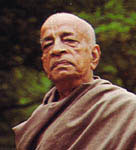 His
Divine Grace A.C.
Bhaktivedanta Swami Prabhupada
His
Divine Grace A.C.
Bhaktivedanta Swami Prabhupada
Founder-Acharya of the world-wide Hare Krishna Movement, Brahma Sampradaya Acharya

PRABHUPADA:
You have given description. May I ask you one question? The
transmigration of the soul, do you take it as science or religion?
PROFESSOR: Yes. Here we take it as religion.
PRABHUPADA: Then what is your definition of religion?
PROFESSOR: My definition of religion is ultimate..., which has to do
with your ultimate concern. Ultimate concern. I mean, I can make
religion out of... If my ultimate concern is money, then that is my
religion, to put it that way. Or ideology and so forth... But it is my
ultimate concern, what is my ultimate concern in life. What is my
ultimate concern. Every man is religious. He's a homo religiosus,
to put it in Latin. He's a religious being. Just as he wants to eat, he
has to have religion.
PRABHUPADA: So the transmigration of the soul, you take it as religion.
It is not a science.
PROFESSOR: We haven't progressed so far.
PRABHUPADA: But so far we are concerned, that is the basic principle of
our further investigation in religion.
PROFESSOR: Yes.
PRABHUPADA: We are preaching Krishna consciousness. That is on the
basis of Bhagavad-gita. So the beginning of Bhagavad-gita
is the teaching of transmigration of the soul. Dehino 'smin
yatha dehe kaumaram yauvanam jara, tatha dehantara-praptih [Bg.
2.13]. So that is our first concern, dehantara-praptih. This
body will not exist, and we have to accept another body. Krishna says, dehantara-praptih,
"another body." Now, there are 8,400,000 different types of body. Which
body I am going to accept, there is no education. So I am kept in
darkness. So what is the value of my education?
PROFESSOR: You mean your future?
PRABHUPADA: Yes. I do not know what is my future. Then what is my
education?
PROFESSOR: Yes. Yes. Of course, that is one standpoint, isn't it?
PRABHUPADA: No, that is the main standpoint. I am taking education in
the university. I do not know what is my future. Then where is the
education? I am in darkness.
PROFESSOR: Yes. But the main thing is, from the Hindu point of view,
you have the...
PRABHUPADA: It is not the Hindu point of view. It is science. Tatha
dehantara-praptih [Bg. 2.13]—that is applicable both for Hindu,
Muslim, Christian, everyone. Just like a Hindu child and a Muslim
child. Does it mean that Hindu child will not grow to become young man?
Only the Muslim will grow? The dehantara-praptih—a child
becomes a boy—that is equally applicable to the Hindus, to the Muslim,
to the Christian, to everyone.
PROFESSOR: Of course, yes.
PRABHUPADA: Then where it is, the religion? It is the science.
PROFESSOR: Yes. But the Christian, for example, says...
PRABHUPADA: No, no. I say from practical... A Hindu child becomes a
boy, and Christian child also becomes a boy. You cannot say that
because you are Christian, you will not become a boy. Can you say like
that?
PROFESSOR: Oh, no.
PRABHUPADA: Or because you are Christian, you will not become an old
man. Can you say like that? So it is the science. So if this science is
not in your university, then you are in darkness.
PROFESSOR: Now we teach it as religion, but whether you take it...
PRABHUPADA: Again you say religion. It is not religion. It is science.
PROFESSOR: Fine. You say it is science; I say it is religion.
PRABHUPADA: Now, you have to say, because you also grow. You shall also
grow old man like me, not that because you are Christian you will not
grow old man like me.
PROFESSOR: In any case...
PRABHUPADA: No, this is the first proposition, that if you keep people
in darkness—he does not know what is his future—
then what is the use of education and university?
INDIAN MAN (2): So do you mean that the university should be abolished?
PRABHUPADA: Not abolished. But education means that you must know what
is your position.
INDIAN MAN (2): With due respect, I want to know what is the line of
demarcation between science and religion.
PRABHUPADA: Science means which is applicable to everyone. Religion is
described in the dictionary, "a kind of faith." Faith... I may be Hindu
today; tomorrow I may be Christian. That is... I can change.
INDIAN MAN (2): But this is not the definition of true religion.
PRABHUPADA: No, no. I am not talking of religion. I am talking of
science. Religion is a kind of faith. You may be believe or you may not
believe.
INDIAN MAN (2): No. There is no question of belief. The question is
whether, what is the difference between religion and science? If
difference is known, then the learned persons can make him right or
wrong at that time, but unless and until the demarcation of line
between religion and science...
PRABHUPADA: Now... Yes, that we can say like this, that "two plus two
equal to four"—this is applicable to the Hindus, Muslim, Christian,
everyone. This is science.
PROFESSOR: Yes. No, no, I understand. I understand. I know where your
argument is going to. But any case, let us beg to differ. Because...
Let us accept it. I just want to say I agree with you in this sense. I
agree with you in this sense, Swami, that if we do not pay attention to
the religious side, then we keep the people in darkness. We have to, on
the religious side too. [introduces Professor Olivier, who has just
entered the room:] Professor Olivier, the rector. ...And this is our
Swami Bhaktivedanta.
PUSTA KRSNA: The principal of the university, Srila Prabhupada. Hare
Krishna. How are you?
PROFESSOR: And Mister Singh from Pietermaritzburg, and Professor
Maharaj you know. And all the other ladies and gentlemen.
PUSTA KRSNA: Would you like to sit beside Srila Prabhupada?
PROFESSOR: Yes.
PRABHUPADA: So you can explain what I was talking.
PUSTA KRSNA: Yes. So the idea is that now you have secular state
because the religion, as it is being taught today, is seen simply as
some kind of dogma that can't be proven, some kind of blind faith. But
in the Bhagavad-gita Krishna is giving scientific
evidence, reason, how the existence of the soul can be proven. Religion
means there must be soul. But people don't understand how soul is
existing. They think it is simply beyond their conception or
comprehension. Krishna has made it so reasonable to understand the
existence of the soul that any sane man would accept. For example,
Krishna says, dehino 'smin yatha dehe kaumaram yauvanam jara
[Bg. 2.13]. Any person can accept that they had a youthful body,
childhood body, and then old man's body. The change of body is always
there. Tatha dehantara-praptih. And after this body we
can reasonably accept that there is another body. Just as from
childhood to youth there is change of body, from youth to old age there
is change of body, similarly, old age, death, and then there is another
change of body. But in all circumstances I am still the same person. My
body is changed, but still I am experiencing that I am the same
identity, the same person. So this education is lacking in the
universities because, generally speaking, all of the scientists in the
universities, they are simply dealing with this body, simply dealing
biology, physics, chemistry—simply with the body. So where is the
question that this is not science? It is science. It is the science of
the soul. When our spiritual master went to Massachusetts Institute of
Technology—it is a very well known technological university—he
questioned the faculty and students there that "You are the most
advanced technological university in the world. Where is that
department that tries to understand the difference between a dead body
and a living body?" So this is science. You can't say that it's not
science. And it should be accepted as science by university professors
and taught as such. Otherwise, if we simply turn our back on this
philosophy... Krishna says, raja-vidya: "This is the king of
knowledge." This is not some sentimental proposition we are putting
forward, but it is the king of knowledge, that the soul is existing,
and after this body there will be another body. So real education,
therefore... Just like you come to the university. You want to get a
better job, not that you go to the university so that you can work an
elevator when you come out. You go to the university to increase your
standard of living, to have higher standard of living. So real
education, similarly, is that you can have higher standard of existence
in your next life, not that I come to the university and simply live
like animal and then have to be demoted to the body of an animal in my
next lifetime. Rather, the real education is how we can be elevated
from this human existence to higher existence, or to spiritual, eternal
existence. So the purpose of the science of Bhagavad-gita
is just this, that janma karma cha me divyam evam yo vetti
tattvatah [Bg. 4.9]. If you understand God in truth, and fact,
then tyaktva deham punar janma naiti: [Bg. 4.9] you will never
take birth again in this material world, but you will go back to the
spiritual world, called Vaikuntha in Sanskrit language. Vaikuntha means
the spiritual world, the place where there is no repetition of birth
and death.
PRABHUPADA: No anxiety. No anxiety.
PUSTA KRSNA: No anxiety. Yes.
INDIAN MAN (3): Excuse me, sir. We recognize six great religions of the
world. Are you suggesting that the adherents of all the other religions
of the world should accept as a science this doctrine of reincarnation
or transmigration of soul? Are you suggesting that everyone,
irrespective of the faith that they belong to, should accept the
doctrine of reincarnation? Is that what you are suggesting?
INDIAN MAN (4): Another question is...
INDIAN MAN (3): I want an answer, please. Are you suggesting that every
person, whether he is Muslim or Christian or Buddhist or Jew or Parsi
or anybody else for that matter, should accept the Hindu doctrine of
transmigration or reincarnation of soul in order that he may be called
really a religious person or a scientific person?
PRABHUPADA: Well, the difficulty is that we are talking of
transmigration of the soul on scientific basis. But you are trying to
give it a Hindu color. Why? To become... I have already explained. To
become old man is equally applicable to the Hindus, Muslim, Christian.
So why you say it is Hindu belief? It is not Hindu belief. It is a
science. Why you are bringing "Hindu, Muslim, Christian"? I do not know
why.
INDIAN MAN (4): The real question between this statement of Mr.
Professor and you is that what is religion and what is science. Unless
the nature of science and religion defined...
PRABHUPADA: Yes. Science is applicable to everyone.
INDIAN MAN (3): But when you use reason for proving your...
PRABHUPADA: Yes. This is the reason, that a child is becoming boy, a
boy is becoming a young man, a young man is becoming...
INDIAN MAN (3): Reason is the subject of logic, and logic is
philosophy. So philosophy is the knowledge of generality, while the
science is knowledge of particularity. Philosophy can be the subject of
religion, but not the science can be the subject of religion. It is
knowledge of particularity.
PRABHUPADA: It is not religion. First of all forget religion. I am
talking of science. That a boy is becoming young man and young man is
becoming old man, this is science. What do you think, Principal? It is
science or religion? Does it mean that only the Hindus become old men
and the Christians do not?
PROF. OLIVIER: Yes... My problem as a simple layman is how to make God
relevant to the issues of the day. But since God's relevancy can only
be related to the permanent, the problem becomes even more complicated.
But I have to deal with practical situations. Everybody in a
university...
PRABHUPADA: This is practical situation, that...
PROF. OLIVIER: Yes, I would agree. It is one of the neglected avenues
of learning that we have not been able scientifically, I think...
PRABHUPADA: Yes, that is my point. That is my point.
PROF. OLIVIER: This is the point that he's trying to make, that we have
not been able to absorb into scientific studies those spiritual
components which go up to make the whole of man. And I would agree. I
think it's one of the great shortcomings in our modern educational
system, that we... Not that we do not accept this. I think basically,
as an intrastructure, we accept this. But it's like a house. When you
look at all the superstructures you do not inquire too deeply about the
foundations of that superstructure.
PRABHUPADA: Yes. Thank you very much. [chuckles]
PROF. OLIVIER: And now your point is that the time has come for society
and the world to find out if there are cracks in the superstructure.
Whether these cracks are just superficial cracks or whether they are
caused by foundational cracks or shifts in the corners of the
foundational structure. And I, like you, I believe that this is not
entirely a question of... Well, it's certainly not a question of
whether it's Hinduism or Christian or Islam.
PRABHUPADA: It is the foundation.
PROF. OLIVIER: It's the foundation. But we know so little about the
foundation. When the rich man in the Bible asked the Lord to send this
poor man down to warn his brothers, the Lord said they've had all the
prophets all the years and they haven't listened. Any new evidence they
will not accept either. I think that we have enough evidences around
us. We need not seek more evidences, except I believe, through more
direct contact with the workings of the holy spirit itself, which I
think is available. But again, which I agree with you, I don't think we
have exploited enough. You could use that word advisedly. Because the
spirit is there. "It bloweth where it listeth." It is for us to get
attuned to that spirit. And now the point is, that we are concerned
with: Who is going to do this? There has just been written a book in
England, which I haven't read, and I hope to order it, but I've only
seen the advertisement, namely, The Biology of God, which
takes into consideration the points that you have raised here. Of
course, there are a lot of objections to this book in principle. You
know—how can a man try to biologize God, to give Him a physical,
scientific being in terms of modern life? But I think in the last book
in the Old Testament, Malachi, there is a, when the Lord was
complaining about all these people who bring blind animals as a
sacrifice or lame animals or weak animals... The poorest in their flock
they bring as sacrifices to the Lord. And He said, "It's not sacrifices
that I want at all, if you bring this kind. It's obedience. It's truth.
It's only truth that brings knowledge. It's truth that I want." But
then He goes on to say you must... This is the challenge that you were
referring to: how do we open more windows from God or from the spirit
of God onto this present world today? Of course, the good Lord is still
God. And He uses... [break]
PROFESSOR: I include the transmigration of souls and I include
everything else, religion and the lot. But when I speak about science
in the English language sense, science in this sense, then I have a
problem.
PROF. OLIVIER: Even the German word wissenschaft that we
normally use, which covers, as you say, everything—this is not
translatable. The word science is...
PRABHUPADA: But in Sanskrit there are two words, jñana
and vijñana. Jñana means theoretical
knowledge, and vijñana means practical knowledge. So vijñana
is taken as science. Just like you... Theoretically you know that two
hydrogen-oxygen mixed together becomes water. And when you do it
practically in the laboratory, that is science, vijñana.
So jñana-vijñana-sahitam. In the Bhagavata
it is said, jñanam me paramam guhyam
yad-vijñana-samanvitah. Knowledge of God should be
practical application in life. That is vijñanam. And
according to our philosophy, unless one has got perfect knowledge of
his self-identification, he remains an animal.
PROF. OLIVIER: He is what?
PRABHUPADA: He remains an animal. Just like a dog is thinking, "I am
dog." So similarly, if I think, "I am Hindu," then what is the
difference? Or if I am thinking, "I am this or that," with the bodily
conception of life... Yasyatma-buddhih kunape tri-dhatuke
[SB 10.84.13]. If one is thinking in terms of bodily conception—"I am
this body"—and based on this foundation, sva-dhi kalatradishu
bhauma-ijya-dhih, our family, society, national, so many things
we are building up on this bodily conception of life... So,
yasyatma-buddhih kunape tri-dhatuke
sva-dhih kalatradishu bhauma-ijya-dhih
yat-tirtha-buddhih salile na karhicij
janeshv abhijñeshu sa eva go-kharah [SB 10.84.13]
Such person is no better than the cow and the asses because he is giving his identification with this body, which he is not. And Vedic realization is aham brahmasmi: "I am not this body; I am spirit soul." And the Bhagavad-gita explains,
brahma-bhutah prasannatma
na shochati na kankshati
samah sarveshu bhuteshu
mad-bhaktim labhate param [Bg. 18.54]
One,
when he is on the platform of Brahman realization, then he becomes
jubilant, prasannatma, na shocati na kankshati. That life is
required, Brahman realization. That is education.
PROF. OLIVIER: But now do you not think that Christianity and Islam
accept this as well?
PRABHUPADA: I do not say which religion accepts and which religion does
not, but unless one understands that he is not this body—he is
different from this body—his education is imperfect.
INDIAN MAN (2): But do... I mean that up till now your excellency were
giving the question of transmigration, field of science, and now you
are also taking that subject of God in this sphere of science?
PRABHUPADA: It is not God. God is far away. First of all I must know
what I am. God is long, long distant.
INDIAN MAN (2): But what should be the...
PRABHUPADA: First of all you understand what you are, whether you are
this body or something other than the body. That is first.
INDIAN MAN (2): Whether we are different or separate from God, or we
are God. [laughter]
PRABHUPADA: That also dog can say, "I am also God." That is not very
difficult thing.
INDIAN MAN (2): Whether God says or not, it is the question between us,
whether we are God...
PRABHUPADA: So, that bodily conception of life is dogism. Dog thinks,
"I am dog." Cat thinks, "I am cat." Similarly, if I think "I am Hindu,"
"I am Christian," so what is the difference? Because you are giving
some name of religion, therefore you are better than dog?
INDIAN MAN (2): With due respect, I want to know the God knows that He
is God and dog knows he is dog?
PRABHUPADA: Why do you bring God? I am not talking of God.
INDIAN MAN (2): Dog. Dog.
PRABHUPADA: I am talking of the soul.
INDIAN MAN (2): Whether dog knows that he is dog?
PRABHUPADA: Yes. He knows the body—"I am dog." That's all.
INDIAN MAN (2): Not about body. I am asking the question whether dog
knows that he is dog. Cow knows that she is cow?
PROFESSOR: Have they got the intelligence to know?
PRABHUPADA: Unless he knows that "I am dog", why he is barking?
[laughter]
INDIAN MAN (2): Dog is barking, but does he possess discriminative
knowledge?
PRABHUPADA: That you do not know. Because you are not dog, you cannot
understand what dog is thinking. You cannot say what dog is thinking.
You cannot say what dog is thinking because you are not dog. But you
have to become dog. Then how dog is thinking... For the present time,
as you do not know what is dog...
Scientific Basis of Transmigration of the Soul/ WORLD SANKIRTAN PARTY ©2004 - Hansadutta das
Home | About | Events | World Sankirtan Party | Inside Nam Hatta
eBooks | Site Map | Store

Sri Guru and Gauranga
Related Articles
The Founder Acharya
The Challenge
Life Comes From Life
No Missing Link and No Species Extinct
Molecules to Chicken: Definition of Life
Soul Research
Fundamental Unit of Life
Related Topics
Science
Life After Death
Back to Top
Back to Top
Back to Top
Back to Top
Back to Top
Back to Top
Back to Top
Back to Top
Back to Top
Back to Top
Back to Top