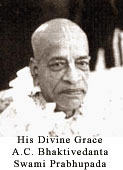
His Divine Grace A.C.
Bhaktivedanta Swami Prabhupada
The
Sunday Times
- January 28, 2007 - The Sunday Times - Review The wrong kind of freedom endangers the West Liberalism
cannot be based on group rights because not all groups uphold liberal
values. The civilisation of the European enlightenment, of which
contemporary liberal democracy is the heir, cannot be culturally
neutral since liberal societies have their own values regarding the
equal worth and dignity of individuals.
Cultures that do not accept these premises do not deserve equal
protection in a liberal democracy. Members of immigrant communities and
their offspring deserve to be treated equally as individuals, not as
members of cultural communities. There is no reason for a Muslim girl
to be treated differently under the law from a Christian or Jewish one,
whatever the feelings of her relatives.
Multiculturalism, as it was originally conceived in Canada, America and
Europe, was in some sense a “game at the end of history”. That is,
cultural diversity was seen as a kind of ornament to liberal pluralism
that would provide ethnic food, colourful dress and traces of
distinctive historical traditions to societies often seen as numbingly
conformist and homogeneous. Cultural diversity was something to be
practised largely in the private sphere, where it would not lead to any
serious violations of individual rights or otherwise challenge the
essentially liberal social order.
By contrast, some contemporary Muslim communities (and those of other
religions) are making demands for group rights that simply cannot be
squared with liberal principles of individual equality. These demands
include special exemptions from the family law that applies to everyone
else in the society, the right to exclude non-Muslims from certain
types of public events, or the right to challenge free speech in the
name of religious offence (as with the Danish cartoons incident). go to
story
According
to Vedic culture, it is the duty of the government to protect the
religious principles. Formerly, the government leaders were not
elected, but they were appointed on the basis of their character and
spiritual strength. Not by popular votes—that is a new thing, and that
is not working very well. It was the duty of the king to protect the
principles of religion. Unfortunately, in this age we see that the
leaders, the presidents, prime ministers, they do not protect religious
principles. They do the opposite. They support irreligious principles.
At least, in Western countries we will find it is the government that
is supporting the liquor industry. It is the government that is
supporting the gambling casinos. It is the government that is
supporting illicit sex in the form of night clubs, hotels, cinemas. So,
the whole world is now steeped in irreligion, although people claim, "I
am a Hindu", "I am a Christian", "I am a Buddhist", "I am a
Mohammedan". In fact, they do not follow their religion, they are
rubber-stamp Christians, rubber-stamp Buddhists, rubber-stamp Hindus,
but on principle there is no observance of religious principles. more
Prabhupada: So there are now many secular
states. Our Vedic idea of secular state is the government must be
responsible of proper execution of religious system. It doesn't matter
whether one is Hindu or one is Christian, one is Mohammedan or
Buddhist. It doesn't matter. But it is a government duty to see that
one who is professing as Hindu whether he's executing the Hindu
principles of religion properly. That is government. Just like
government gives license to so many businesses. One man is selling
liquor, wine, government issues license. So the government inspector,
excise inspector, goes and sees that the man is doing business
according to the license. Government should not be callous that "You
may go on with your so-called religion, we don't care for it." No. That
is not government. Government's duty is to see, just like for example,
Christians, their commandment, first commandment is, "Thou shalt not
kill." It is the government's duty to see that anyone who is professing
Christian, "Why he's killing?" Immediately he should be punished that
"You are professing as Christian and you are killing." This is
government. Similarly, Buddhist religion also, ahimsa. Ahimsa
paramam buddhih. The government duty should see.
And
the ultimate
test of first-class religion is: the follower has developed love of
God. If he does not know anything about God, or if he has not developed
love of God, then he has simply wasted time. It may be any religion.
That is ultimate test because religion means, it has got relationship
with God. Otherwise what is the meaning of religion? Any religion, it
doesn't matter. The process should be quest of God. What is God? What
is Absolute Truth? Wherefrom everything has come? What is we... what we
are? What is our relationship with God? This science. Religion means
this science. In the Vedanta-sutra, it is said, athato
brahma jijnasa. This human life is meant for understanding the
Absolute Truth. Otherwise, what is the difference between cats and dogs
and human beings? If simply eating, sleeping, and sex life, and defend
is the business of human life, then these things are there in the
animal life also. They also eat. They also sleep. They have also sex
life, and they also defend according to their capacity. We defend with
atomic bomb and they defend their own nails and claws. The different
spirit is there. So that is not the aim of human life. The aim of human
life—this opportunity's given by nature to have a human form of life—is
to understand God. Nobody can deny—unless he is a crazy fellow—the
existence of God. That is not possible. There must be. I may know it or
not know it, it doesn't matter. Therefore religion means to understand
God and to awaken your dormant love for God. This is religion.
Now
there may be difference of process, according to country, time, people.
Therefore, it is the duty of the government, it is the duty of the
government. Formerly the kings, they were regularly supervising that
their citizens were properly executing religious culture. That was
government's duty. Chatur-varnyam maya srishtam
guna-karma-vibhagashah [Bhagavad-gita 4.13]. So now
government is callous about religion. I'm very glad to know that your
government has left some department to supervise. What is your function
in this department?
Guest 2: Excuse me, my
English is very poor. I would like Mr. Kunti to translate, Indonesian.
Devotee: He would like to
have him translate English to Indonesian.
Prabhupada: Yes.
Guest (2): He is the director
of the office of Hindu and Buddhist religion, from Department of
Religious Affairs. His duty is to maintain and look after the
development of [indistinct] expecting that all people of Indonesia that
has to follow any kind of religions, such as Christians, because we
have also in charge for the Christianity, we have also in charge for
the Muslim, or Islam, and we have also in charge for the Catholic and
we have also in charge for other...
Prabhupada: Very good idea.
This is very nice.
Guest (2): So because we have
so many in the prosecuting of their religions, there might be, the
people between many religions cause for misunderstanding. So the
government have to lead the people how [indistinct], to supply also, in
the way of their materials for readings, and facilities for their,
prosecuting their religions. This is the actual purpose of the
department.
Prabhupada: So this is the
idea which I was explaining that...
Guest (2): As a matter of
fact, also that we are looking from the Hindu and Buddhist religions'
point of view, how to get materials for this department, especially
because we are feeling of lacking of materials because none of our
books actually here, written in ancient Indonesian language, which are
translated from Sanskrit...
Prabhupada: Ancient
English...?
Guest (2): Ancient Indonesian
language.
Prabhupada:Accha.
Guest (2): And now actually,
most of the Sanskrit texts also, are not available anymore. Of course
we have some few can be available from India, and that is why actually,
to develop this new religions, as well as the Buddhist religion, which
have a lack of material for reading. Now the government also tried to
rewrite into Indonesian bhasa [language],
and as one of the aspects, for example, that Bhagavad-gita
has been translated into Indonesian.
Prabhupada: Mmmm.
Guest (2): Which we are
expecting that this Bhagavad-gita should be read by
English reading people, and also, matter of fact, most of English
readers can understand and they have the ideas of the Mahabharata,
and Ramayana, and the essence of the Bhagavad-gita.
Now the problems, at least the department has been facing difficulties
to supply materials that are actually needed by the people, is we are
lacking of materials. So how, actually we have to solve this problem
actually. We are actually, from the government point of view, always
looking and how we can try to get international relationships between
various countries to solve the problems. As the same case also how to
educate Indonesian peoples to study more about the Hinduism in order
they can teach the Hinduism because in our country religious
instruction is compulsory in our, any institution. So we felt, actually
in our lack of material as well as lack of institution to develop this
Hindu religions. And I, from our government actually, we are expected
your visit here that it will be beneficial, both for our side, from the
government point of view, and as well as for here and as well in your
country.
Prabhupada: So I think your
problems can be solved if you kindly cooperate with us.
Guest (2): Yes. That's why we
are looking for... because...
Prabhupada: We can give you
correct idea of religious principles as well as our philosophy.
Guest (2): Yes.
Recognizing
bona-fide religion
Prabhupada: Religious idea without
philosophy is sentiment, and philosophy without religion is mental
speculation. They should be combined. Religious idea supported by
philosophy. Then it is correct. And philosophy without religious idea
is simply mental speculation. They should be combined. That combination
of religious idea and philosophy, you'll find in the Bhagavad-gita,
provided you accept Bhagavad-gita as it is. If you
interpret Bhagavad-gita in your own way, then you'll miss
the point. Just like in our country, in India, Bhagavad-gita
has been interpreted in so different ways that people are now
bewildered. They do not know what is actually Bhagavad-gita.
Take, for example... Just like in the beginning of the Bhagavad-gita,
it is said, dharmakshetre kurukshetre samaveta yuyutsavah
[Bg. 1.1]. I
think you know Sanskrit. Samaveta yuyutsavah mamakah pandavash
caiva kim akurvata sanjaya [Bg. 1.1]. Even a great leader,
political
leader, he has interpreted kurukshetra as this body. So where
is the
dictionary where kurukshetra means this body? But because he's
a big
political leader that gita is going on. Kurukshetra
means this
body. Pandava means the five senses. In this way
misinterpreting the Bhagavad-gita ...they
cannot arrive at the truth. I may tell you frankly. Just like Mahatma
Gandhi,
he wanted to prove nonviolence from Bhagavad-gita. Bhagavad-gita
is spoken in the battlefield, and how he can prove nonviolence from Bhagavad-gita?
Then he has to drag some interpretation out of his own way. But because
he's a big leader the people are misled. Similarly, all... at present
moment in India the Bhagavad-gita has becoming a
plaything that anyone can interpret in his own way and do all nonsense.
But I'll request you, because you are so much interested, and you have
already approved Bhagavad-gita, you have translated.
Amongst the leading personalities, you try to understand Bhagavad-gita
as it is and spread it, it will have immediate effect. That is already
experimented. Just like in western countries, before me, hundreds and
thousands, swamis and yogis went there. But not a
single person could
understand what is Bhagavad-gita, and what is Krishna.
Now hundreds and thousands of these boys in Europe, America, Canada,
Africa, everywhere, Australia, everywhere, they are now become
devotees... So they're intelligent persons, they're coming from rich
family. Why they have taken seriously? Because they have understood Bhagavad-gita
nicely.
So I request that God is neither Indonesian, neither Indian,
neither African, God is God. And He claims that all living entities, in
any form... The form is superficial. The form is taken as dress. Just
like you are dressed in a different way, I am dressed in a different
way. But we are not talking to the dress, we are talking to the man who
is putting on the dress. Similarly, this bodily distinction is
material. But spiritually we are all one. There is no question of
becoming Indian or Indonesian or African or Asian or this or that. And
that is stated in the Bhagavad-gita. You know. Panditah
sama-darshinah. Vidya-vinaya-sampanne
brahmane gavi
hastini shuni chaiva shvapake cha panditah sama-darshinah [Bg.
5.18]. Because pandita [a learned man]
does not see the outward dress, pandita sees the inside, who is
putting on the dress.
Therefore,
without misinterpreting Bhagavad-gita, or being misled by
so-called big, big leaders, if you try to understand Bhagavad-gita
as it is, it will be very nice, beneficial to everyone. That is my, not
opinion, but is the fact. Things should be taken as it is. Call a spade
a spade. Now, interpretation is required when things are not clear.
When things are not very clear, not easily understood... There is
example in Sanskrit grammar, gangayam ghosha bali[?]. The
neighborhood of Ghosha family is on the Ganges. Now, on the
Ganges-Ganges is water—how there can be a village? Now, here
interpretation required. When the matter is not plainly stated, ...not
on the water but
on the bank of the Ganges. So when the meaning is not clear, then you
can interpret. But when the meaning is clear... Just like Bhagavad-gita:
dharmakshetre kurukshetre samaveta yuyutsavah [Bg.
1.1]. Now
Kurukshetra is still there, in... about 90 miles away from Delhi.
Perhaps you have been there. The station is there, Kurukshetra. Now how
one can interpret that kurukshetra means this body? This is going on.
In spite of clear understanding, they interpret in their own way so
that they have got their own philosophy, they want to support. This is
going on. So if you kindly avoid this misleading interpretation, and if
you take Bhagavad-gita as it is, then you get the science
of God, science of religion, which is applicable either to Indonesian
or Indian or African or American, everyone. The science is appreciated
everywhere. Two plus two equal to four, this mathematical science is
applicable everywhere. It doesn't matter whether one is a Christian or
Hindu or Muslim. Similarly, Bhagavad-gita is the science
of religion, science of God. So if you take this book seriously, and
try to spread this knowledge among your countrymen, I think you'll be
very much benefited. And it can be... We are preaching that. We are
the, our Krishna consciousness movement, is meant for one God, one
scripture, one mantra, like that, for all people of the world.
And we
are happy that people are accepting it in that way, very nicely. And it
is very easy. It is very easy.
So Mr. Director he has read Bhagavad-gita?
Guest (2): Yes. He has read
it.
Prabhupada: Very good.
Guest (2): And I think many
Indonesian people, actually have read this Bhagavad-gita
because we have translated that Bhagavad-gita
in 1966.
Prabhupada: I see. Very nice.
So have you read our, this Bhagavad-gita As It Is?
Guest (2): Yes.
Prabhupada: You like it?
Guest (2): [indistinct]
because when I was in India [indistinct].
Prabhupada: So religion must
be there. Without religion the human society is animal society. There
must be religion. And religion means to know God. That is religion.
What is your explanation of religion?
Guest (2): Actually
[indistinct] religion has to be defined as [indistinct]
Prabhupada: What is that
[indistinct]?
Guest (2): [indistinct] to
understand religion is [indistinct]
Prabhupada: Yes. They must be
the same. Dharmam tu sakshad bhagavat-pranitam [SB
6.3.19]. Religion means the course, or the laws given by God. Just like
law means the law given by the state. I cannot manufacture law. The
citizen cannot manufacture law. The law is manufactured by the
legislative assembly of the government. Similarly, religion means the
order given by God. Now we have to understand who is God, and what is
His order, and how it is applicable to everyone. That is the system of
religion. We cannot whimsically give some rituals as religion. The
principle of religion is to obey the orders of God. Therefore the first
principle is to know who is God. Unless I know what is God, then how I
can know what is His order? So in the Bhagavad-gita, the
religion is given that the Bhagavad-gita, it is said that
sarva-dharman parityajya mam ekam sharanam vraja [Bhagavad-gita
18.66]. That is religion. We have manufactured so many types of
religion, and here God says that "You give up your manufactured
religion. You just surrender unto Me." This is religion. Religion means
to surrender. A good citizen means to surrender to the government law.
Similarly, a religious person means who has surrendered to God.
Nowadays it has become a regrettable fashion that everyone is God, when
we surrender to one. And this false prestige that "I am God. I haven't
got to surrender to anyone. I am God. What surrender?" This atheism is
going on and spoiling the whole human society. God has become so cheap.
Any nonsense can claim, "I am God." That is the defect of the modern
society. There is a great necessity to understand God. If everyone is
God then where is the necessity of religion? If everyone is president
then where is the necessity of lawmaking? So this is going on. This is
very unfortunate situation. What is your idea?
Guest (2): We find that in
our Hindu text, for example, that when it's expressed aham brahmasmi,
so...
Prabhupada:Aham brahmasmi
is the Vedic version, that is all right. Aham brahmasmi means,
"I am spirit. I am not this body." So 'ham means, "I am the
same quality as God." But they are misinterpretation: So 'ham
means, "I am God." This is nonsense. This is going on.
Guest (2): That's misleading.
Prabhupada: Misleading.
People have become nonsense. You have published Bhagavad-gita
with commentary or simple translation?
Guest (2): With commentaries.
Prabhupada: So whose
commentary you have followed?
Guest (2): We try to take
from various books and we try, at first we have to understand clearly
their positions, then we put them in a simple way that everybody can
understand it clearly. Only the part that's very difficult to
understand.
Prabhupada: Now here, Bhagavad-gita,
in the Fourth Chapter it is said, imam vivasvate yogam proktavan
aham avyayam [Bg. 4.1]. You can open to the Fourth Chapter.
Guest (2): But according to
our opinions that religion is something that true living.
Prabhupada: Something?
Guest (2): Something that we
should live truly.
Prabhupada: True living. Yes.
True, just like good citizens...
Guest (2): That's right.
Prabhupada: Good citizenship
means living under the direction of the government. That is good
citizenship. Similarly, human life means to live nicely under the
direction of God. The cats and dogs, they cannot understand. But the
human life, [pause] That first verse: imam vivasvate yogam
proktavan aham avyayam, vivasvan manave praha manur ikshvakave 'bravit
[Bg. 4.1]. So what is your explanation of this verse?
Guest (2): You want to
explain this into ... Do you want to explain this?
Guest (2): Yes. This actually
is explaining the origins of the law, ancient law, that's obeyed by the
man. It's the law given from the Vedic literature...
Prabhupada: Krishna.
Guest (2): Yes. Krishna
explained to Vivasvan, and coming to Ikshvaku and...
Prabhupada: Yes, that
actually means, that means this knowledge should be received from the
authority.
Guest (2): Yes.
Prabhupada: Just like...
Guest (2): So actually they
have acquired it from one source.
Prabhupada: Yes. One link. So
that is being deviated. What Krishna said to Vivasvan, to the sun-god
now everyone is speaking in his own way, not in that way.
Guest (2): That's right.
Prabhupada: Therefore it is
deviated. The Bhagavad-gita, the Chapter, Fourth Chapter
explains that you cannot understand Bhagavad-gita by your
own interpretation. You must follow the instruction of the original
speaker of Bhagavad-gita. The original speaker is
Krishna. So what Krishna says, they have to follow it. Then it is Bhagavad-gita.
Otherwise if you interpret it in a different way then it is not Bhagavad-gita.
Now, what Krishna says we have to understand it philosophically,
ethically, scientifically, any way, any angle of vision. That is, that
you can do. But you cannot change the version of Bhagavad-gita.
You cannot change. Just like Dr. Radhakrishnan, in the Ninth Chapter
when Krishna says, man-mana bhava mad-bhakto mad-yaji mam
namaskuru [Bg. 18.65]. Dr. Radhakrishnan says "It is not to the
Krishna person." But Krishna person says, man-mana bhava
mad-bhaktah, "You just always think of Me." And he's deviating
his readers, "Not to Krishna." How much harm he's doing. This is going
on. Why? It is said, Krishna says, man-mana bhava mad-bhaktah,
"Just think of Me. Just become my devotee." What right he has got to
say that here it is not to Krishna? This is going on. So if we
interpret in that nonsense way then we shall not be able to understand Bhagavad-gita.
We shall miss this point. Science does not mean that you have to change
according to your whims. Two plus two equal to four. You cannot make it
five or three. That is not possible. Then it is not science. No longer
the scientific value of this two plus two remains. We follow that
principle, and that is the only principle. So if you're actually
serious about Bhagavad-gita... I do not know what is your
commentary. I request you: Try to follow the instruction of Krishna.
Don't interpret in your own way. Then it will be successful. Everyone
has got [indistinct] all over the world. Therefore we are selling this Bhagavad-gita
As It Is very nicely. Our publisher is MacMillan Co., and their
trade manager's report is that our Bhagavad-gita is
increasing daily, sales, other decreasing. That is the report, and in
October they published 50,000 copies. It is already finished. Now they
have to plan it for the second edition. People are very much now, eager
to read Bhagavad-gita As It Is. So, imitating us,
somebody's, another [chuckles] man, he said "Bhagavad-gita As It
Was." [laughs with everyone] Like that. So that will not harm
our cause.
Guest (2): One thing Mr.
Kunti would like to answer from you, that, according to different view,
objective reply, the object of this human life, the objective of our
religion is to be prosperous in this world and hereafter.
Prabhupada: No. This is
not... Prosperous. That is also stated, how you can become prosperous.
That...
Guest (2): The problems work
like this...
Prabhupada: No. That is also
stated...
Guest (2): Whether this
question also...
Prabhupada: Yes, yes. This is
there...
Guest (2): This what it is.
Prabhupada: Yes. In the Bhagavad-gita
you'll find this verse. [Aside:] Find out this verse. Bhoktaram
yajna-tapasam sarva-loka-maheshvaram [Bg. 5.29]. Bhoktaram
yajna-tapasam sarva-loka-maheshvaram, suhridam sarva-bhutanam jnatva
mam shantim ricchati. This is the shanti, prosperity.
They are... Krishna says that "I am the Supreme Enjoyer. I am the sole
proprietor of everything." Sarva-loka-
maheshvaram. Sarva-loka, not only of this planet, but
other planets also. Loka. Loka means planet, sarva-lokam.
So bhoktaram yajna-tapasam sarva-loka-maheshvaram, suhridam
sarva-bhutanam. "I am the best, I mean to say, well-wisher
friend of everyone." Jnatva mam shantim ricchati. If one
understands these three things only: (1) that God is the Supreme
Enjoyer. We are not enjoyer. But God is Enjoyer. (2) That God is the
Proprietor of everything. Not we are proprietor. We are subordinate.
(3) In the Vedas also, it is stated, eko bahunam
yo vidadhati kaman, nityo nityanam chetanash chetananam. Eko bahunam yo
vidadhati kaman (Katha Upanishad 2.2.13). The
description of God is like that He's eternal amongst the eternals. We
are also eternal, the living entities. And God is also eternal. Nityo
nityanam... chetana, He's the vital living force among all living
forces. We are all living forces and He's the chief living force. Then
what is the distinction between this singular number, nitya,
and the plural number, nityas? The distinction is that that
singular number, nitya, is maintaining this plural number, nityas.
Eko bahunam yo vidadhati kaman. That is the
distinction. Otherwise God is also a living entity like us, like one of
us. But he's the chief. Just like father and children. Father is the
chief man in the family and he's providing all necessities to life for
the children, for the wife and family. Although the father is also
living entity and the children are also living entities, but the father
is providing the children, and the children are being provided by the
father. So this is the understanding. Unless we understand this, there
cannot be any peace. That is the Vedic version. Anyone who understands
this, he gets peace. Otherwise there's no possibility of peace. If I
think that I am the proprietor, if I think that I am the enjoyer, or,
in other words, I am God, then you'll never get peace. That is not
possible. That is a false. If one of the children thinks that, "I am
the independent", then naturally father will say, "All right, if you're
independent, do your own business." This is an example. So if you want
peace then, as it is stated in the Bhagavad-gita, you
have to learn these three things. It is not very difficult. (1)To
accept God as the Supreme Enjoyer, and (2) God as the sole proprietor
of everything, and (3) He's the best friend of everyone. Then you have
peace. Anyone can appreciate this. Anyone can adopt this principle and
he'll be in peace. And so long one will falsely think that "I am God. I
am enjoyer, I am this, I am that." Then he'll suffer. False notion will
never make him happy. He must come to the true, factual idea. Now you
can examine that Krishna says that "I am the Supreme Enjoyer." Now let
us understand this one fact, how Krishna's the enjoyer. Now suppose
here is some banana fruits. Who has created this banana fruit? You are
not manufacturer, I am not manufacturer. Somebody has created. We
accept God has created and that's a fact. Then who should be the
enjoyer? I shall be enjoyer or God shall be enjoyer? Anything you
create, you become the enjoyer. Anything I create, I become the
enjoyer. So if God has created this banana fruit, then who should be
enjoyer? God or I?
Guest (2): God.
Prabhupada: Yes. So our
business is, we should offer this banana to God. "So it is Your
creation, it is Your thing. First of all You taste it, then we take
it." Then you become in peace. And if you falsely think that "I have
created this banana tree. I have worked so hard. Now the fruit is
there. Now I am the enjoyer." Then you are mistaken. Then next
statement is, bhoktaram yajna-tapasam sarva-loka mahesh...
[Bg. 5.29], "I am the proprietor of everything in the world." Now,
beginning of this world Bhumi... land, this land, they're claiming this
land Indonesian, this land American, this land Indian. But have the
Indonesians or the Africans or the Indians created this land? Who has
created this land?
Guest (2): God.
Prabhupada: Then He must be
proprietor. But we are falsely claiming that, "I am the proprietor." So
how you can be in peace? Suppose you steal something, somebody's
property, and falsely claim, "I am proprietor," you'll never be peace
because it is not your thing. You have stolen it. So in this way, if
you... philosophy can be studied that God is the Supreme Proprietor, tena
tyaktena bhunjithah [Ishopanishad mantra 1]. You
can simply use what is given to you. You cannot claim other's property.
Just like in animal life, animal life, they do not claim that "This is
my country." The birds, they do not claim, but they live very
peacefully. There are crows, there are sparrows... What is called? So
many birds, they live anywhere, everywhere, but they do not claim, "Oh,
this is my country. This is my place." They do not claim. Therefore
they are free to move everywhere. So we have created a situation,
Godless situation, therefore we are not in peace. So therefore, if you
want peace, you must accept God, first of all. Suhridam
sarva-bhutanam jnatva mam shantim ricchati [Bg. 5.29], this is
the way of shanti. You cannot create your shanti in
your own way. That is not possible. Just like the citizens, if they
create their own way of shanti, there cannot be peace. If they
abide by the orders of the government, by the laws of the government,
there will be peace. This is crude example. Similarly, if you do not
accept God in the center as the Supreme Proprietor and the Supreme
Enjoyer and the Supreme Friend, then there is no peace. This is the
problem, I have given in the... What is that? You read it?
Devotee: [Reads:] Bhoktaram
yajna-tapasam sarva-loka-maheshvaram, suhridam sarva-bhutanam jnatva
mam shantim ricchati [Bg. 5.29]. "Translation: The sages,
knowing Me as the ultimate purpose of all sacrifices and austerities,
the Supreme Lord of all planets and demigods and the benefactor and
well-wisher of all living entities, obtain peace from the pangs of
material miseries."
Prabhupada: Purport.
Devotee: [Reads:] "The
conditioned souls in the clutches of the illusory energy are all
anxious to attain peace in the material world. They do not know the
formula for peace which is explained in this part of the Bhagavad-gita.
The greatest peace formula is simply this. Lord Krishna is the
beneficiary in all human activities. Men should offer everything to the
transcendental service of the Lord because He is the proprietor of all
planets and the demigods thereon. No one is greater than He. He is
greater than the greatest of the demigods, Lord Shiva and Lord Brahma.
In the Vedas the Supreme Lord is described as param
ishvaranam paramam maheshvaram. Under the spell of illusion,
living entities are trying to be lords of all they survey. But actually
they are dominated by the material energy of the Lord. The Lord is the
master of material nature and the conditioned souls are under the
stringent rules of material nature."
Prabhupada: That is the
defect. Lord is the master of material nature, and we are conditioned
by the material nature and still we are claiming, "I am God." Then?
Devotee: [Continues reading:]
"Unless one understands these bare facts it is not possible to achieve
peace in the world, either individually or collectively. This is the
science of Krishna consciousness. The Lord Krishna is the Supreme
Predominator and all living entities, including the great demigods, are
His subordinates. One can attain perfect peace only in complete Krishna
consciousness. In the Fifth Chapter is the practical explanation of
Krishna consciousness, generally known as karma-yoga. The
question of mental speculation as to how karma-yoga can bring
liberation is answered herewith. To work in Krishna consciousness is to
work with the complete knowledge that the Lord is the predominator.
Such work is not different from transcendental knowledge. Direct
Krishna consciousness is bhakti-yoga. And jnana-yoga is
the path leading to bhakti-yoga. Krishna consciousness means to
work in full knowledge of one's relationship with the Supreme Absolute
and the perfection of this consciousness is full knowledge of Krishna
or Supreme Personality of Godhead. A pure soul is the eternal servant
of God as His fragmental part and parcel. He comes into contact with maya,
illusion, due to the desire to lord it over maya. And that is
the cause of his many sufferings. As long as he is in contact with
matter he has to execute work in terms of material necessities. Krishna
consciousness, however, brings one into spiritual life even while he is
in the jurisdiction of matter, for it is an arousing of spiritual
existence by practice in the material world. The more one is advanced,
the more he is free from the clutches of matter. The Lord is not
partial toward anyone. Everything depends on ones practical performance
of duties in an effort to control the senses and conquer the influence
of desire and anger. And attaining Krishna consciousness by controlling
the above mentioned passions, one remains factually in the
transcendental stage of
brahma-nirvana. The eight-fold yoga mysticism is
automatically practiced in Krishna consciousness because the ultimate
purpose is served. There's a gradual process of elevation in the
practice of yama, niyama, asana, pranayama, pratyahara, dharana,
dhyana, and samadhi. But these only preface perfection by
devotional service which alone can award peace to the human being. It
is the highest perfection of life."
Prabhupada: Therefore in
another place, it is stated, bahunam janmanam ante jnanavan mam
prapadyate [Bg. 7.19], "After many, many births, when actually
becomes wise, jnanavan mam prapadyate, he surrenders unto
Me." That is the perfection of knowledge. So this is... The Bhagavad-gita
is the only source of scientific knowledge of God and our relationship
with God. I am very glad that you are already very serious about
understanding Bhagavad-gita. But I request you only that,
try to... and understand Bhagavad-gita without any, our
man-made interpretation. That will be my request.
Guest (2): What is one thing
that I would like to...
Prabhupada: And we are always
ready to help you in this.
Guest (2): Yes, thank you for
this. What I wanted, that if you will be able to help us...
Prabhupada: Oh yes, oh yes.
Guest (2): ...in
establishing, for example, that Gita meeting for some...
Prabhupada: Oh yes.
Guest (2): [indistinct]
Prabhupada: Oh yes. Our
Krishna consciousness movement is practically preaching the teachings
of Bhagavad-gita as it is. And it is coming fruitful. It
is coming very fruitful.
[conversation in Indonesian between guests]
Prabhupada: Please translate.
Guest (2): He said, as a
matter of fact, this Hindu religion in Indonesia, actually, most of
them practicing Bhagavad-gita. So Bhagavad-gita
has been a part of their life, but as a matter of fact, because in
practicing this Bhagavad-gita, not all the teaching has
been practiced but only part by part which is very necessary for the
adjustment with the condition in Indonesia. Some of them, of course,
they can memorizing the verses for their benefit in their practices.
Prabhupada: So we are always
prepared to help you, anytime you require our help. [indistinct]
...try, we shall very much try to explain Bhagavad-gita
as it is.

 The
Sunday Times
- January 28, 2007 - The Sunday Times - Review
The wrong kind of freedom endangers the West
The
Sunday Times
- January 28, 2007 - The Sunday Times - Review
The wrong kind of freedom endangers the West
