
Krishna Books
What is Hare Krishna?
The Founder-Acharya
Hare Krishna Mantra
Sankirtan Movement
Personality of Godhead
Lord Chaitanya
A.C.Bhaktivedanta Swami Prabhupada
Hansadutta das
Events: Kirtan Festival
World Sankirtan Party
Submit News
© 2004 - Hansadutta das
Purify the Pollution
A.C. Bhaktivedanta Swami Prabhupada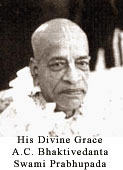
 The New York Times
- Sunday, October 29, 2006 - by
BOBBIE ANN MASON, Op-Ed contributor - Pick Your Poison
The New York Times
- Sunday, October 29, 2006 - by
BOBBIE ANN MASON, Op-Ed contributor - Pick Your Poison
...Consider our weapons-of-mass-destruction site, the Blue
Grass Army Depot in Richmond, where a stockpile of chemical weapons has
been languishing since World War II. At least 55,000 rockets, with 523
tons of chemical weapons, are stored in shabby igloos. How to dispose
of toxins like mustard gas and sarin has been a debate for decades. And
the stuff is prone to pesky leaks. But at last Kentucky is getting a $2
billion federal plant that will neutralize the weapons by separating
the chemicals and washing them in water. It's a pilot plant, to find
out if this process will really work.
Local leaders insist on local hiring so the community can benefit
economically. So the government contractor plans to recruit teenagers
at high schools, vo-tech schools, even church groups, to train them for
careers in working safely with weapons of mass destruction. One
procedure will involve cutting the heads off chemical-filled rockets
with something like a pipe cutter.
Then there are the leftover contaminants from the cold war. The Paducah
uranium-enrichment plant has been cleaning up its old piles of
radioactive uranium, tritium, plutonium and what-have-you, and now it
has a chance of opening a major recycling plant for nuclear waste from
all over the globe. It would treat spent fuel rods from nuclear
reactors in order to salvage the residue of radioactive uranium and
plutonium for use in power plants.
As part of the Bush initiative to recycle nuclear waste, the
contaminated byproducts would come (by flatcar? 18-wheeler? FedEx?)
into our state. Importing deadly radioactive stuff would be a boon for
the community, creating up to 6,000 jobs, so you can't argue. Or can
you?
That's not all. Kentucky's politicians have also proposed building a
$451 million lab for the study of pathogens that might be unleashed in
a bioterrorism attack (ebola, anthrax). Before the boom in weapons of
mass destruction, Kentucky's economy depended on its land. But with
farms disappearing, country life is becoming a memory. full story

excerpt from Conversation with John Popworth and E.F. Schumacher, July 26, 1973, London
|
Modern
Progress
|
Advancement of Civilization by HANSADUTTA DAS Everybody has to give something for something they get. that is the law of nature: give and take, action and reaction, an eye for an eye, tooth for a tooth, do unto others as you would have them do unto you. We can't escape this. If we can understand this basic principle of life, then we shall give up the foolish notion of getting something for nothing. Material scientists and politicians and economists are trying to get something for nothing. They think they can exploit material nature and enjoy some profit. They do not know that everything which they take from nature has to be paid for. They have to pay. more |
Revatinandan: So Mr. Popworth you know, and
Mr. Schumacher will be up in a second.
Prabhupada: Yes, you came
here before.
Revatinandan: Yes, that's
right.
Prabhupada: How are you?
Mr. Popworth: My invariable
reply, sir, is that I am dying slowly. I trust you are well, sir.
Prabhupada: Yes. Old man,
struggling. Spiritual consciousness is not dependent on material
impediments.
Mr. Popworth: I'm not hearing
these beautiful words.
Revatinandan: [to Mr.
Popworth:] He remarked that the spiritual consciousness is not impeded
by material impediments-like the body.
Mr. Popworth: I discovered
that when I was a cook. I used to have to peel a huge bath full of
potatoes every day, hours and hours, and it became that I could peel
the potatoes without being aware that I was handling them. And my mind
was roaming, disembodied almost from any encumbrance. But this is not
the same as meditation, I'm sure, as you see it.
Prabhupada: What is your idea
of meditation? [Dr. Schumacher enters the room] Come on. Hare Krishna.
Revatinandan: Sit over here.
Vichitravirya: This is Dr.
Schumacher.
Prabhupada: Yes. Thank you
very much for your coming. I have read some of your ideas. So from your
writing it appears you are nice, thoughtful man. Muni... the
Sanskrit word is muni. Just like Narada Muni. They are very
thoughtful. So I have read one description of, "Crisis of Increasing
Motor Cars," in this paper. Actually, we are creating a crisis. This
advancement of modern civilization is simply creating crisis. One
Vaishnava poet, he has sung: sat-sanga chadi kainu asatye vilasa.
Sat-sanga means spiritual association. So we have given up
spiritual association, and asatye vilasa, we have taken to
material enjoyment. So sat-sanga chadi kainu... There are
two things, material and spiritual. So sat-sanga chadi kainu
asatye... "I have given up spiritual association, and I have
taken to material association. Therefore I have become entangled." Sei
karane lagila mora karma-bandha-phansa. We are becoming more and
more entangled in material activities. We are trying to solve one
problem, and creating another big problem. Just like I was reading the
"Motor Car Crisis." We thought that with a horseless carriage it will
be very convenient to travel. But against that convenience, so-called
convenience, we have created so many inconveniences. It is very nicely
described in that paper I was reading.
Revatinandan: Was it this one?
Prabhupada: Yes.
Revatinandan: It's a reprint,
"Economics of Permanence," your essay.
Prabhupada: What is that?
Revatinandan: It's called
"The Economics of Permanence."
Prabhupada: Yes. "The Motor
Car Crisis"?
Revatinandan: Is it mentioned
in that essay? I think it must be a different location.
Vichitravirya: I think it was
in one of the Resurgence magazines, perhaps. It was in one of the eight
magazines, I think.
Prabhupada: Yes, yes, yes.
Here.
Mr. Popworth: The one on
Buddhist economics.
Dr. Schumacher: No, it was
the other one. This is "The Economics of Permanence."
Mr. Popworth: Oh.
Prabhupada: Hm. "Cars,
Profits and Pollution." I was just reading this article. "Cars, Profits
and Pollution." So this one side, we make profit, another side, we make
pollution. This is the material, result of material activities.
Whatever you do. Anything you do material, it is same. In one side, you
see, "Oh, there is so much profit," and another side, you'll see so
much pollution. Therefore the remedy is to act for spiritual
realization. Then you will avoid pollution. The remedy is. If you...
That is described in the Bhagavad-gita, in the Third
Chapter, how we can work for spiritual realization and avoid the
pollution of material activities. This is the sum and substance of Bhagavad-gita.
In the Bhagavad-gita, we do not avoid the material
activities, but we become free from the material pollution. This is the
secret of Krishna consciousness movement.
Mr. Popworth: How do you
envisage one should act, if I may ask that?
Revatinandan: He said, how do
you envisage that one should act. How should one act? He's asking.
Prabhupada: That you will
find in the Bhagavad-gita. Just like Arjuna. He was a kshatriya,
a warrior, but he acted on account of Krishna. We are acting, but we
are acting at the present moment for our sense gratification. Everyone
is thinking that "If I do like this, it will give me great
satisfaction." That is my sense gratification. I am acting for my
satisfaction, not for Krishna's satisfaction. So when we act for
Krishna's satisfaction, that is the perfection. Then we save the
material pollution. This is the secret. Arjuna is a good example.
Before fighting, he was thinking in terms of his own satisfaction. But
when he understood Bhagavad-gita and he agreed to act for
Krishna's satisfaction, then he became perfect. So our, this Krishna
consciousness movement is so nice that we do not say immediately to
stop. Just like "Cars, Profits and Pollution," the very nice
description of these three things. But there is no suggestion of
remedy. That he does not know. If he suggested remedy, "Now stop all
cars driving," or "Stop this nonsense business," that is impossible.
That is craziness. So we do not say that you stop it. But we say,
purify it. Just like there is pollution. So pollution is there. You
cannot stop manufacturing cars or driving cars. That is not possible.
But you can purify the pollution. That is possible.
Mr. Popworth: It's possible
to what?
Prabhupada: Purify.
Mr. Popworth: Purify the
pollution.
Prabhupada: Yes.
Mr. Popworth: Yes.
Prabhupada: That is Krishna
consciousness movement. Nirbandhah krishna-sambandhe yuktam
vairagyam uchyate. So everything should be done—that is called karma-yoga—in
Krishna consciousness. Under the direction of Krishna. Just like Arjuna
is doing. He did not change his position as a fighter, as a warrior.
But he acted according to the direction of Krishna. Therefore he is
recognized: bhakto 'si priyo 'si [Bhagavad-gita
4.3]. "You are My dear friend. You are My devotee." This is the
process. So we have to purify. We cannot stop. That is not possible.
The progress which is going on, let it go. But let it go, we do not
want that, but it has come so far, it is not possible to stop it. But
here is the remedy. You can purify it.
Mr. Popworth: What means do
you suggest for purifying it?
Prabhupada: The means is
that... Our process is that wherever we go, we perform sankirtana,
chant the holy name of God. That purifies, cheto-darpana-marjanam
[Chaitanya-charitamrita Antya 20.12]. It doesn't matter
where it is. Even if we... We can go to the factory. Anywhere. We can
go to the hell even. By, but this process, it is a very simple thing,
chanting the holy name of the Lord. So what possible objection can
there be? Suppose if we go to a motor car factory, and we ask them,
"Please give us some chance. We shall chant here the holy name of the
Lord." What their... what is the possible objection? You are very
thoughtful man. You can say.
Dr. Schumacher: I don't see
the point.
Prabhupada: Eh? There cannot
be any objection.
Dr. Schumacher: No.
Prabhupada: Yes. So let us
get this chance. Simple method. So we'll go. Let us go everywhere, hell
or heaven. It doesn't matter. Let us have this chance and speak
something about God. That's all. And we don't want anything from you in
exchange, that "You give us some money." No. We don't want. If you give
us something, welcome. It will be used for Krishna's service. But we
don't demand anything, that "First of all give me a hundred dollars,
then I shall go." No. So... From the other side, there is no loss. But
if they give us the chance for prosecuting, for pursuing, this Hare
Krishna Movement, everything will be purified. Cheto-darpana-marjanam
bhava-maha-davagni... [Cc. Antya 20.12]. All problems will be
solved. This is the beginning. Now, gradually, as people understand
this philosophy, they will understand. They will understand. If they
simply give us the chance. Sthane sthitah. Let them remain in
their
position. We don't disturb. We don't disturb. Sthane sthitah
shruti-gatam tanu-van-manobhih. Simply they will kindly give
their aural reception what we are speaking.
Mr. Popworth: Well, the
diagnostic's not altogether clear to me how the chanting is going to
affect the pollution. How do you see...?
Prabhupada: It is a
purificatory process. Pollution means impure. So if you purify, then
there is no more pollution. Just like infection. You have got some
disease, infection. If you give some vaccine to purify the body, the
infection is gone. It is like that.
Revatinandan: It seems that
there's a difference in the usage of this word pollution.
Prabhupada: Eh?
Revatinandan: I think there's
a difference in the way the word pollution is being used.
Prabhupada: Yes, whatever
meaning you may do...
Revatinandan: So, for
instance, if it is used to indicate air pollution...
Prabhupada: Yes.
Revatinandan: ...then how
will the chanting will affect that?
Prabhupada: Yes, it will
affect.
Revatinandan: He's asking how.
Prabhupada: How? That you do
not know. You'll have to realize when you give us the chance. But if
you give us the chance, there is no loss on your part. But you'll
practically see how it is rectified, how it is...
Vichitravirya: Pollution is
to some extent a result of materialistic activity?
Prabhupada: Hm?
Vichitravirya: The pollution,
is it to some extent the result of material activity, which will cease
when the spiritual...
Prabhupada: Yes, there are so
many things. What is material activity, what spiritual activity is.
These are to be understood. But we are sure, if simply this chance is
given, anywhere, let us execute this Krishna consciousness movement by
chanting Hare Krishna maha-mantra and speaking something from
this Bhagavad-gita. We are getting practical result. Just
like you were describing, that in communist country.
Hansadutta: Ah...
Prabhupada: You just explain
to them.
Hansadutta: They have a big
youth festival there in East Berlin. Maybe you know? "The Festival of
Youth."
Mr. Popworth: Yeah.
Hansadutta: So they have
invited youth from all over the world to come and see what they are
doing there. So some of our devotees went there just the past week. And
they reported to me that at every moment during the day that they were
there they were surrounded always by at least three hundred young
people who simply stood taking notes and asking questions about this
Krishna consciousness. They want to know what is this Krishna
consciousness, what they are doing. That means that there is some
dissatisfaction. They want something. They want something substantial.
And they're getting it from Krishna consciousness. This philosophy is
substantial. It is practical. They are hankering for it. Their
so-called communist philosophy is not perfect. It's imperfect.
Mr. Popworth: They were
communist youth who were surrounding?
Hansadutta: Yes.
Mr. Popworth: The people.
Hansadutta: Yes. They were
surrounding our devotees and asking questions and taking notes and
taking addresses.
Mr. Popworth: But the people
who are at the conference are not all communist youth, are they?
Hansadutta: Well, whoever
they may be, they've gone there with some interest about communism.
Otherwise, they would not go there. So this Krishna consciousness...
Actually, Krishna consciousness is perfect communism, Prabhupada always
explained, because communism, so-called communism, they give advantage
only to the human being, but not to the animals or the other living
beings. But Krishna consciousness is pure, genuine, absolute communism
because we recognize that the Supreme... Everyone should work for
Krishna. Everything should be utilized for Krishna. So Krishna is the
supreme head of state, and everything is utilized for His purpose, His
service. Just like Krishna says, "Whatever you do as work, whatever you
eat, whatever you give away, you do it for Me." The same philosophy...
Communist philosophy is "Everyone works for the state; the state will
distribute." Right? But it's imperfect. But here is the perfect thing.
Krishna, He is the supreme creator, He's the proprietor. Therefore
everything must be used for His pleasure. Then it becomes perfect
communism.
Prabhupada: Instead of making
the state center, make God center.
Mr. Popworth: Do you think
that the Christian monasteries practiced this in the past, or perhaps
even today?
Hansadutta: Well, today, no
one is practicing it. Otherwise why people are leaving the church? No
one is in the monastery, no one is in the church. They are abandoning
it. Because there is no center. As soon as there is a center, it will
carry weight. Just like a wheel. If there's a hub, if there's a hub,
that it will carry weight.
Mr. Popworth: I have not
abandoned the church. I have embraced it.
Hansadutta: Anyway, our point
is... We're speaking in general. In general, because the center,
factually the center, God, is missing, somehow or other, He's missing,
therefore people are also giving it up. They can't take it. Because
it's not practical. Krishna consciousness is practical. It's not a
sentiment or a dry philosophy. It's a practical philosophy of life,
absolute philosophy of life, how to do everything without any
pollution, without any contamination. Just like we are experiencing by
our so-called advancement that we have created so many modern
facilities for comfort, but the result is, alongside, simultaneously,
there's an equal disadvantage. Just like we create a motor car. But we
create air pollution. Or you create a highway. But you have to create
snowplow to clear the highway. You have to create police. You have to
create so many other things.
Prabhupada: And there is list
of accidents, injuries.
Hansadutta: Yes.
Revatinandan: And just like
yesterday, Mahadeva's parents came here, his mother came here along
with a Jesuit family priest, about sixty years old. And she accused us
that we had come and kidnapped him out of the university. And we said,
"Actually, we didn't kidnap him. He came to our temple and didn't want
to go away," which is what happened. She said, "Well, that's because he
took some LSD and he had a false religious experience." So then I asked
the Jesuit priest, "If your religious experience is as pure as he had
just been saying, then why was this boy, trained up in a Jesuit school,
seeking after spiritual life from a false religious process? Why was he
taking LSD in the first place if his religion was satisfactory?" And he
couldn't answer it. He said, "Well, there seems to be some kind of a
spiritual," what did he say, "a spiritual lack or a spiritual something
at this time for some reason." But he would not define it that he was
unable to fill that spiritual lack by his process. And yet, we have
filled that lack, or our spiritual master has filled that lack for
thousands of young people now, who are not only God conscious, but
they're practicing it every minute of every day. And they're practicing
it practically, in the city or in the community or in the farm or
wherever they are. So it's not that we're contesting the origins. The
origin from Christ may have been very pure, but its present
manifestation appears to be lacking something. And the young people are
seeing that.
Prabhupada: Just for example,
that in the Ten Commandments, the first Commandment is "Thou shall not
kill." So when I ask any Christian gentleman, "Then why you are
killing?" they cannot give me any satisfactory answer.
Revatinandan: How does the,
how does the process of animal slaughter in the slaughterhouse as we
find it today, how does it fit in your philosophy for, say, changing
the society? Where do you put that in your philosophy?
Dr. Schumacher: Well, I think
one should try and do without it. You can't everywhere do without it.
It's like all nonviolence. It's a direction of movement, to try to do
your utmost to go as far as...
Revatinandan: So wherever
possible, the slaughtering business should not go on.
Dr. Schumacher: That's right.
But the Eskimos, for instance...
Prabhupada: That is another
thing.
Dr. Schumacher: That's what I
was saying, you see.
Prabhupada: When there is no
food, so human life is more important than animal life. So the human
life should be saved at the sacrifice of animals. That is another
question. But where there is complete facilities to get very nice,
nutritious food, why these poor animals should be killed?
Revatinandan: But in the last
week we've had a Jesuit priest, a Black Friar's monk, several other
theologically inclined Christian gentlemen have been here, and not one
of them has assented to that statement. They do not agree. They think
that...
Prabhupada: They do not agree
that animal killing is sinful. They do not agree.
Dr. Schumacher: It's a very
long question, isn't it. I mean...
Prabhupada: No, it is a
simple question. Killing, do you think killing is very good business?
Then why it is forbidden, "Thou shall not kill."
Dr. Schumacher: No, but
sometimes protection is necessary.
Prabhupada: That is another
thing. Generally, you should not kill. But when there is absolute
necessity, that is another thing. But generally, this killing process
you cannot support, and at the same time, you want to make the society
purified. You commit sinful activities; at the same time, you want to
purify. How it is possible?
Dr. Schumacher: I think a
society can survive, and spirituality can survive, even among
meat-eaters. It's much more difficult, I imagine, that a society can
survive which has animal factories. Now, I would be much more
interested whether we can get our friends, the Dominicans, the Jesuits,
to agree that this kind of a treatment of animals is just so, beyond
the pale. This would be, in the European context, I think, a better
test than to challenge the habit of meat-eating, which is also
intergrown with all sorts of assumptions. I mean there is the ruling
assumption that you need it, which I challenge and you challenge.
Revatinandan: See, the habits
are one thing. If we understand that it is an undesirable habit, they
can be changed. All of us are from meat-eating backgrounds, almost
without exception. We've all strictly stopped. We've stopped taking
intoxicants. We've stopped gambling and we've stopped illicit sex life,
although we were habituated to doing these things, because we came to
understand that it was necessary for the advancement of our spiritual
life. But the difficulty is that somebody who is so much engrossed in
this kind of life, who has made it a pillar of his life, and that by
the psychological effect of such habits, he comes to the stage of being
so stony-hearted that he does not see the miserable suffering he's
putting the animals to unnecessarily. He has no sense for it. Even if
it's graphically described to him... I described it to this monk about
how conscious the cow is compared to, say, the cauliflower. He couldn't
see any difference. No distinction.
Mr. Popworth: I'm sorry.
Distinction between what?
Revatinandan: The distinction
between killing a cow and cutting off a cauliflower from a plant. He
said, "Both are alive." Yes, both are alive. But what is the
psychological state of a cow, and what is the psychological state of a
cauliflower plant? Practically speaking, he has no psychology. No
senses, no mind, no ability to feel elation or suffering. But a cow is
a completely different condition. Cow is very nearly to human
consciousness. Practically the next birth after a cow, according to the
Vedas, is a human birth. So you're putting so much
suffering unnecessarily. But he had no sense, not... An intelligent man
who can sense that "If I suffer, I don't like it," then when he sees
another living entity put into suffering, he thinks, "How I could avoid
that suffering for that living entity, because I don't like to suffer."
But this gentleman had no conception. He's...
Prabhupada: There is one
moral instruction by Chanakya Pandita. Chanakya Pandita was a great
minister during the time of Maharaja Chandragupta. So he was honorary
Prime Minister in the empire. So he has a book on moral instruction. So
he says in that moral instruction who is a learned man. So he gives the
description of a learned man, that: matrivat para-dareshu.
Matrivat. "Just treat all other women except your wife as your
mother." Matrivat para-dareshu, para-dravyeshu loshtravat.
Loshta means as there are so many pebbles lying on the
street, you don't care for it, similarly, others' property, others'
money you should treat just like these pebbles lying on the street or
the garbage lying on the street. Don't touch it. So matrivat
para-dareshu para-
dravyeshu loshtravat, atmavat sarva-bhuteshu. And treat all
living entities as you want to be treated. If one has got these three
qualifications, he is learned man. He does not say, one who has got
this BAC, DAC degrees, and so on, so on, so on. No. The result of his
education is to be seen by three manifestations: treating all women as
mother; treating others' money, property, as garbage, as rubbish in the
street; and treating all living entities as you want to be treated
yourself. If one has attained these three development of knowledge, he
is learned. There is no question of literary education. Matrivat
para-dareshu para-dravyeshu loshtravat. So if we covet other's
wife, if we eat meat, if we indulge in intoxication, if we indulge in
gambling, we are polluting the whole society. So how we can expect
purification unless we accept these principles? You cannot ignite fire,
at the same time pour water on it. Similarly, if you want to purify the
whole society, the first principle should be like this, as Chanakya
Pandita says,
matrivat para-dareshu
para-dravyeshu loshtravat
atmavat sarva-bhuteshu
yah pashyati sa panditah
Women
should be treated as mother. They should be given protection. They
should not be advertised for prostitution. All living [beings] should
be given protection. This is the government's duty. A king's duty is
government duty, that anyone who has taken birth on the land, he must
be protected. It doesn't matter whether he's human being or animal or
tree. So these are the process of purification. If you don't adopt the
process, simply you think the counterside only, there is no wor... So
this Krishna consciousness movement will purify the whole situation.
Therefore we expect.
Mr. Popworth: I wonder if I
could put the point which Dr. Schumacher has made somewhat more
forcefully if possible. I am surprised that in the exchange the point
he made was not taken and answered. What is at issue is that in your
beliefs you are saying it is wrong to kill an animal. It is possible, I
don't say this to justify the killing of animals. But it is possible
for an animal to be killed by a man in a way that involves far less
suffering to the animal than it would die in its natural state. But
what seems to be such an infinitely greater evil, an infinitely greater
crime against the natural order is, for example, to take one chicken
and put it in a cage the size of a shoe box, and then add more two more
chickens to it, and then keep them there for the whole of their short
natural life, unnatural life. But it seems to me, and, I think, to Dr.
Schumacher, that this is an abomination of the spirit far greater than
the mere killing of animals. But if it... It seems to be an insult
against creation to treat the animal life in this manner. And yet, you
do not appear to be shocked by it as you are shocked by the mere fact
of killing.
Prabhupada: It is more
shocking than killing?
Mr. Popworth: Far more.
Vichitravirya: What happens
is they have large factories where they have thousands and thousands
and thousands of chickens in a very tight space, and they breed them
for slaughter.
Prabhupada: Oh.
Mr. Popworth: And young cows,
calves are kept in a dark shed, deliberately kept in a dark shed and
fed on an unnatural diet. They are not allowed to move, they are just
kept in a space the size of their body. And for eight weeks, three
months, they are fed on unnatural food, milk powder or something,
devoid of certain necessary vitamins, to make the flesh whiter so that
it gets a market. But that unfortunate beast, instead of walking in the
fields under the open sky, he's shut him down.
Prabhupada: All right, if you
are so compassionate, you can kill those animals. But why you are
maintaining slaughterhouse, killing nice animals.
Revatinandan: No, he's
talking... He's just saying that the way they're maintaining the
slaughterhouse now has become even more inhuman. They don't even leave
the animal in the field anymore. They keep him...
Hansadutta: One small point.
A simple point is that the slaughterhouse activity necessitates to
raise them in that way. As soon as there is a question of animal
killing, then naturally, you want to be as expedient as possible. So if
you abolish the animal killing, automatically this breeding animals in
this fashion will also automatically stop.
Mr. Popworth: But the
slaughterhouse becomes a temple of mercy given these conditions in
which the animals are...
Hansadutta: Yes. As long as
you maintain a slaughterhouse, then there'll be people to breed animals
to supply to the house of slaughter.
Prabhupada: It is nice.
Hansadutta: As soon as
there's no more slaughterhouse, then the animals are free. They can go
everywhere.
Mr. Popworth: I think you are
avoiding the point.
Revatinandan: No. It's the
solution. If you want to stop that treatment of animals, you stop the
slaughterhouse. Otherwise, first you keep them in the field to
slaughter. That's already brute mentality. That brute mentality means
next I think, "I could get more flesh if I didn't let this cow move. So
let me keep him in a case, cage, in the dark so they have lighter
meat." This is one stage of brute mentality to another stage of brute
mentality. The next stage of brute mentality... They're already killing
the unborn child. Now, next, the child is born. That's the next stage
of brute mentality. That is predicted in the Vedas.
Prabhupada: Now, their theory
is that when the child comes out of the womb, then he gets the soul. Is
it not?
Revatinandan: Yes.
Prabhupada: Not within the
womb.
Hansadutta: Yeah.
Prabhupada: What kind of
theory it is? For killing the child within the womb, they have
discovered this theory.
Dr. Schumacher: I think if
there is any difficulty... Well, I happen to be a vegetarian.
Revatinandan: Yes.
Dr. Schumacher: But I would
hesitate a long, long time before I would make meat-eating the
touchstone on which I would judge a Jesuit. I don't think I could see
such a central position. And the evils that are going on that have to
be fought are, in comparison with meat-eating, gigantic. And therefore,
to refuse to accept that even a meat-eating Jesuit may be a far better
man than a vegetarian who is engaged in all sorts of nefarious
practices, I think one should be a bit careful. If you come out of a
civilization where this has been customary all, all throughout
history...
Hansadutta: Therefore all
throughout history...
Dr. Schumacher: Yes, I know.
I haven't...
Hansadutta: ...you haven't...
Why hasn't there been peace in our civilization? Because we're
practicing these four things: meat..., animal killing, intoxication,
illicit sex life and gambling. According to Vedic scripture, these four
activities are the sum and substance of sinful life, and sinful life
means...
Prabhupada: Pollution.
Hansadutta: Pollution. Or
reaction. You're getting... Just like you make an automobile; you get
the reaction-air pollution. So if you kill animals, you will be killed.
Mr. Popworth: You think like
this?
Hansadutta: And intoxication
itself means that you are polluted. Toxic means poison. Poison means
pollution. So if you indulge in intoxication, everything you do, say
and think will be polluted. If you kill animals, the result is you're
polluting nature's... There are laws of nature. Animal is part of
nature. You're part of nature. So if you disturb nature, that means
you're polluting the nature. And you are living in that nature. So you
are suffering the reaction.
Dr. Schumacher: The Buddhists
have got a good, a good formula on this, and...
Hansadutta: It's common
sense. That's all.
Prabhupada: It is not the
question of Buddhist, Christian or Hindu. It is common sense philosophy.
Dr. Schumacher: The Buddhists
have a good compromise on this. They say you can eat meat...
Prabhupada: No, no strict
Buddhist will say.
Dr. Schumacher: ...but
because you're not allowed to kill animals for eating meat.
Prabhupada: What is this?
Dr. Schumacher: So they let
the Muslims kill the animals.
Revatinandan: Let the Muslims
kill, and if I take... If the Muslims kill the animal, and I take the
meat, I become animal-killer.
Dr. Schumacher: Well, that
is...
Revatinandan: If I sell the
meat if I cook the meat, if I distribute the meat if I eat the meat I'm
the same as the man who slaughters the animal. This is Vedic... There's
a Vedic verse that explains it.
Vichitravirya: As a matter of
course.
Prabhupada: Eight kinds of
criminals. In killing animals, there are eight kinds of criminals. That
he has explained. One who is killing, one who is ordering, one who is
purchasing, one who is eating, one who is cooking, in this way... Just
like if a man is killed. If a man is killed and there are so many
persons implicated, it does not mean that only one who has killed, he
becomes criminal. All others who are implicated in that killing
business, they are criminals. This is pollution.
Revatinandan: This, this...
Dr. Schumacher: Let me make
myself clear. I happen to be a vegetarian.
Revatinandan: That's all
right. We understand that. We're talking about the matter, the issue.
Dr. Schumacher: But you know,
if one lives here in this society, even the elimination of these four
things doesn't do it.
Revatinandan: Oh, it changes
everything immediately.
Dr. Schumacher: I mean a
fellow who builds himself a huge house when we have twenty-thousand
actually, actually homeless people without a roof over their head in
London... Now I would like those things to be raised into real
spiritual problems.
Hansadutta: Yes, let them
come here. We will...
Dr. Schumacher: And not to
get satisfaction out of making idealistic...
Hansadutta: Yes, we have such
a big place, but why they are not coming? We have temples all over the
world, but people are not coming.
Prabhupada: Because there are
restriction.
Dr. Schumacher: That is not,
that is not... That doesn't meet my point. My point is...
Hansadutta: Why not? If they
have no place to live, let them come and live here. We are convinced
that Krishna can provide place for any number of His...
Prabhupada: Millions.
Hansadutta: ...devotees. Any
number.
Mr. Popworth: I found this
the other day, and you'll forgive me making this point, but when I was
in discussion, it was impossible for me to make a point without being
interrupted so frequently that I failed to make my point at all. Now,
can I beg for courtesy for our guest to listen to what he has to say.
Then answer him.
Revatinandan: But... Just
that this is interesting, that the solution is there...
Dr. Schumacher: But you
haven't heard the problem yet.
Revatinandan: But the problem
is that people cannot understand the solution. They cannot understand.
Prabhupada: But one thing...
Revatinandan: Why they cannot
understand?
Prabhupada: Mister, yes... I
forgot your name.
Mr. Popworth: John.
Prabhupada: John, Mr. John.
That we follow strictly the Vedic injunctions, and unless we become God
conscious, there cannot be any reformation in this world.
Mr. Popworth: I agree with
that.
Prabhupada: That's all. And
that God consciousness cannot be achieved without being pure. In the Bhagavad-gita
it is said, param brahma param dhama pavitram paramam bhavan
[Bg. 10.12]. God is the supreme pure. You cannot approach God, you
cannot understand God, in impure condition. And without God
consciousness, there cannot be any purification. You try to understand
this simple fact, that without God consciousness, you may prescribe so
many things—they will be all failure, all failure. And God
consciousness cannot be achieved without being pure. This is the
problem. Now you can think over it.
Dr. Schumacher: I agree with
that.
Prabhupada: Yes. You can
defend your theory but that will not help purification of the society.
That will not help. Take it for granted. You can make so many theories
but if you remain impure, if you are not God conscious, all these
theories will be useless. Harav abhaktasya kuto mahad-guna
mano-rathe... [
Srimad-Bhagavatam 5.18.12]. This is simply mental speculation. Mano-rathena,
hovering on the mental plane, you can jump from this to that, but that
will not solve the problem. Mano-rathenasati dhavato bahih.
So we do not act on mental speculation. It may be our credit or
discredit. That is different thing. We simply follow the standard
policy. That is Krishna consciousness.
Purify the Pollution/ WORLD SANKIRTAN PARTY ©2004 - Hansadutta das
Home | About | Events | World Sankirtan Party | Inside Nam Hatta
eBooks | Site Map | Store

Sri Guru and Gauranga
Related Articles
Technology Won't Help Us
Utilize for Krishna
Hog Civilization
Advancement of Civilization
Improving on Nature
Cows and Karma
Mud Eruption and Water Shortages: misuse of industry
Capitalizing on Earth's Resources
Population on the Rise (or Fall into Lower Species?)
Related Topics
Aim of Life
Karma - Work
World Community - Government, Economy, Politics
Back to Top
Back to Top
Back to Top
Back to Top
Back to Top
Back to Top
Back to Top
Back to Top
Back to Top
Back to Top
Back to Top
Back to Top
Back to Top
Back to Top
Back to Top
Back to Top
Back to Top
Back to Top
Back to Top