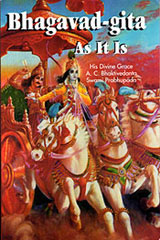
Bhagavad-gita
As It Is by A.C. Bhaktivedanta Swami
Unabridged, unrevised reprint of the 1972 MacMillans ed. $14.95 Buy it now.
[Posted June
9, 2007]
Krishna
Consciousness is Not Hinduism
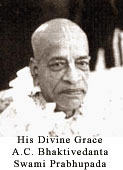
His Divine Grace A.C.
Bhaktivedanta Swami Prabhupada
BBC
News
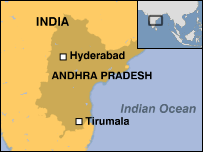
- June 8, 2007 OMER FAROOQ Hindu sites 'only for Hinduism' The government of the southern Indian state of Andhra Pradesh
has banned the propagation of other religions in the holy places of
Hindus across the state.
The authorities say the move is to ensure that Hindu sentiments in holy
places are not offended.
It follows a row over alleged Christian missionary activity around a
shrine in the town of Tirumala. go
to story
Nothing
to do with the Hindu religion or any system of religion excerpt
from Science of Self Realization, "Krishna Consciousness:
Hindu Cult or Divine Culture"
We
must not allow ourselves, this Krishna consciousness movement, to be
equated with or drawn into the same arena with Islam, Judaism,
Christianity, etc. as if all are on the same playing field. People look
at us as if we belong to “just another religion”—”What religion are
you? I’m Christian. Oh, you’re Hare Krishna. That’s nice.” Ordinary
people see many different religions. But that is not at all correct.
There is only one religion, and the original religious codes known to
mankind are the Vedas. The standard for human thought and
action in every field, whether government, military and politics,
health, mathematics, agriculture, astronomy, poetry, music, art,
philosophy—practically every branch of knowledge and human endeavor—is
the Vedas. Vedic culture, Vedic knowledge and Vedic religion
are the foundation of human civilization, just looking at it from a
historical perception. Every other religion is really only a fractional
derivative of the original, pure religion. Like Buddha. He was a Vedic
prince, and derived His outlook of the world from the Vedic perspective
preserved and taught by brahmanas and brought up in a culture
permeated with Vedic tradition, although he later rejected the
authority of the Vedas. Buddhism is therefore a derivative of
some sort from the Vedas. Like opium, morphine and heroine are
all derivatives from poppy seeds. So the closer we get to the source,
the more pure and potent. Vedic religon, culture and knowledge is the
origin of all that has trickled down through the millenia in the form
of art, music, poetry, politics, religion, etc. Actually, the origin
exists still. Thus we can consider that these variant cultures and
religions are aftermarket products. Whatever exists in the world under
the heading of religion is nothing but an adulterated derivative of the
original thing. more
There
is a misconception that the Krishna consciousness movement represents
the Hindu religion. In fact, however, Krishna consciousness is in no
way a faith or religion that seeks to defeat other faiths or religions.
Rather, it is an essential cultural movement for the entire human
society and does not consider any particular sectarian faith. This
cultural movement is especially meant to educate people in how they can
love God.
Sometimes Indians both inside and outside of India think that we are
preaching the Hindu religion, but actually we are not. One will not
find the word Hindu in the Bhagavad-gita. Indeed, there
is no such word as Hindu in the entire Vedic literature. This
word has been introduced by the Muslims from provinces next to India,
such as Afghanistan, Baluchistan, and Persia. There is a river called
Sindhu bordering the north western provinces of India, and since the
Muslims there could not pronounce Sindhu properly, they instead called
the river "Hindu", and the inhabitants of this tract of land they
called Hindus. In India, according to the Vedic language, the Europeans
are called mlecchas or yavanas. Similarly, Hindu
is a name given by the Muslims.
India's actual culture is described in the Bhagavad-gita,
where it is stated that according to the different qualities or modes
of nature there are different types of men, who are generally
classified into four social orders and four spiritual orders. This
system of social and spiritual division is known as varnashram-dharma.
The four varnas, or social orders, are brahmana, kshatriya,
vaishya and shudra. The four ashrams, or
spiritual orders, are brahmacharya, grihastha, vanaprastha, and
sannyasa. The varnashram system is described in
the Vedic scriptures known as the Puranas. The goal of
this institution of Vedic culture is to educate every man for
advancement in knowledge of Krishna, or God. That is the entire Vedic
program.
When Lord Chaitanya talked with the great devotee Ramananda Raya, the
Lord asked him, "What is the basic principle of human life?" Ramananda
Raya answered that human civilization begins when varnashram-dharma
is accepted. Before coming to the standard of varnashram-dharma
there is no question of human civilization. Therefore, the Krishna
consciousness movement is trying to establish this right system of
human civilization, which is known as Krishna consciousness, or daiva-varnashram—divine
culture.
In India, the varnashram system has now been taken in a
perverted way, and thus a man born in the family of a brahmana
(the highest social order) claims that he should be accepted as a brahmana.
But this claim is not accepted by the shastra (scripture).
One's forefather may have been a brahmana according to gotra,
or the family hereditary order, but real varnashram-dharma is
based on the factual quality one has attained, regardless of birth or
heredity. Therefore, we are not preaching the present-day system of the
Hindus, especially those who are under the influence of Shankaracharya,
for Shankaracharya taught that the Absolute Truth is impersonal, and
thus he indirectly denied the existence of God.
Shankaracharya's mission was special; he appeared to re-establish the
Vedic influence after the influence of Buddhism. Because Buddhism was
patronized by Emperor Ashoka, twenty-six hundred years ago the Buddhist
religion practically pervaded all of India. According to the Vedic
literature, Buddha was an incarnation of Krishna who had a special
power and who appeared for a special purpose. His system of thought, or
faith, was accepted widely, but Buddha rejected the authority of the Vedas.
While Buddhism was spreading, the Vedic culture was stopped both in
India and in other places. Therefore, since Shankaracharya's only aim
was to drive away Buddha's system of philosophy, he introduced a system
called Mayavada.
Strictly speaking, Mayavada philosophy is atheism, for it is a process
in which one imagines that there is God. This Mayavada system of
philosophy has been existing since time immemorial. The present Indian
system of religion or culture is based on the Mayavada philosophy of
Shankaracharya, which is a compromise with Buddhist philosophy.
According to Mayavada philosophy there actually is no God, or if God
exists, He is impersonal and all-pervading and can therefore be
imagined in any form. This conclusion is not in accord with the Vedic
literature. That literature names many demigods, who are worshiped for
different purposes, but in every case the Supreme Lord, the Personality
of Godhead, Vishnu, is accepted as the supreme controller. That is real
Vedic culture.
The philosophy of Krishna consciousness does not deny the existence of
God and the demigods, but Mayavada philosophy denies both; it maintains
that neither the demigods nor God exists. For the Mayavadis, ultimately
all is zero. They say that one may imagine any authority—whether
Vishnu, Durga, Lord Shiva, or the sun-god—because these are the
demigods generally worshiped in society. But the Mayavada philosophy
does not in fact accept the existence of any of them. The Mayavadis say
that because one cannot concentrate one's mind on the impersonal
Brahman, one may imagine any of these forms. This is a new system,
called pañchopasana. It was introduced by
Shankaracharya, but the Bhagavad-gita does not teach any
such doctrines, and therefore they are not authoritative.
The Bhagavad-gita accepts the existence of the demigods.
The demigods are described in the Vedas, and one cannot
deny their existence, but they are not to be understood or worshiped
according to the way of Shankaracharya. The worship of demigods is
rejected in the Bhagavad-gita. The Gita
(7.20) clearly states:
kamais
tais tair hrita jñanah
prapadyante 'nya-devatah
tam tam niyamam asthaya
prakritya niyatah svaya
"Those whose minds are distorted by material desires surrender unto
demigods and follow the particular rules and regulations of worship
according to their own natures."
Furthermore,
in the Bhagavad-gita (2.44), Lord Krishna states:
bhogaishvarya-prasaktanam
tayapahrita-chetasam
vyavasayatmika buddhih
samadhau na vidhiyate
"In the minds of those who are too attached to sense enjoyment and
material opulence, and who are bewildered by such things, the resolute
determination for devotional service does not take place."
Those
who are pursuing the various demigods have been described as hrita
jñanah, which means "those who have lost their sense." That
is also further explained in the Bhagavad-gita (7.23):
antavat tu phalam tesham
tad bhavaty alpa-medhasam
devan deva-yajo yanti
mad-bhakta yanti mam api
"Men of small intelligence worship the demigods, and their fruits are
limited and temporary. Those who worship the demigods go to the planets
of the demigods, but My devotees reach My supreme abode."
The
rewards given by the demigods are temporary, because any material
facility must act in connection with the temporary body. Whatever
material facilities one gets, whether by modern scientific methods or
by deriving benedictions from the demigods, will be finished with the
body. But spiritual advancement will never be finished.
People should not think that we are preaching a sectarian religion. No.
We are simply preaching how to love God. There are many theories about
the existence of God. The atheist, for example, will never believe in
God. Atheists like Professor Jacques Monod, who won the Nobel prize,
declare that everything is chance (a theory already put forward long
ago by atheistic philosophers of India such as Charvaka). Then other
philosophies, such as the karma-mimamsa philosophy, accept that
if one goes on doing his work nicely and honestly, automatically the
result will come, without need for one to refer to God. For evidence,
the proponents of such theories cite the argument that if one is
diseased with an infection and takes medicine to counteract it, the
disease will be neutralized. But our argument in this connection is
that even if one gives a man the best medicine, he still may die. The
results are not always predictable. Therefore, there is a higher
authority, daiva-netrena, a supreme director. Otherwise, how is
it that the son of a rich and pious man becomes a hippie in the street
or that a man who works very hard and becomes rich is told by his
doctor, "Now you may not eat any food, but only barley water"?
The karma-mimamsa theory holds that the world is going on
without the supreme direction of God. Such philosophies say that
everything takes place by lust (kama-haitukam). By lust a man
becomes attracted to a woman, and by chance there is sex, and the woman
becomes pregnant. There is actually no plan to make the woman pregnant,
but by a natural sequence when a man and a woman unite, a result is
produced. The atheistic theory, which is described in the Sixteenth
Chapter of the Bhagavad-gita as asuric, or demoniac, is
that actually everything is going on in this way, because of chance and
resulting from natural attraction. This demoniac theory supports the
idea that if one wants to avoid children, he may use a contraceptive
method.
Actually, however, there is a great plan for everything—the Vedic plan.
The Vedic literature gives directions regarding how men and women
should unite, how they should beget children, and what the purpose of
sex life is. Krishna says in the Bhagavad-gita that sex
life sanctioned by the Vedic order, or sex life under the direction of
the Vedic rules and regulations, is bona fide and is acceptable to Him.
But chance sex life is not acceptable. If by chance one is sexually
attracted and there are children, they are called varna-sankara,
unwanted population. That is the way of the lower animals; it is not
acceptable for humans. For humans, there is a plan. We cannot accept
the theory that there is no plan for human life or that everything is
born of chance and material necessity.
Shankaracharya's theory that there is no God and that one can go on
with his work and imagine God in any form just to keep peace and
tranquillity in society is also more or less based on this idea of
chance and necessity. Our way, however, which is completely different,
is based on authority. It is this divine varnashram-dharma that
Krishna recommends, not the caste system as it is understood today.
This modern caste system is now condemned in India also, and it should
be condemned, for the classification of different types of men
according to birth is not the Vedic or divine caste system.
There are many classes of men in society—some men are engineers, some
are medical practitioners, some are chemists, tradesmen, businessmen,
and so on. These varieties of classes are not to be determined by
birth, however, but by quality. No such thing as the caste-by-birth
system is sanctioned by the Vedic literature, nor do we accept it. We
have nothing to do with the caste system, which is also at present
being rejected by the public in India. Rather, we give everyone the
chance to become a brahmana and thus attain the highest status
of life.
Because at the present moment there is a scarcity of brahmanas,
spiritual guides, and kshatriyas, administrative men, and
because the entire world is being ruled by shudras, or men of
the manual laborer class, there are many discrepancies in society. It
is to mitigate all these discrepancies that we have taken to this
Krishna consciousness movement. If the brahmana class is
actually reestablished, the other orders of social well-being will
automatically follow, just as when the brain is perfectly in order, the
other parts of the body, such as the arms, the belly, and the legs, all
act very nicely.
The ultimate goal of this movement is to educate people in how to love
God. Chaitanya Mahaprabhu approves the conclusion that the highest
perfection of human life is to learn how to love God. The Krishna
consciousness movement has nothing to do with the Hindu religion or any
system of religion. No Christian gentleman will be interested in
changing his faith from Christian to Hindu. Similarly, no Hindu
gentleman of culture will be ready to change to the Christian faith.
Such changing is for men who have no particular social status. But
everyone will be interested in understanding the philosophy and science
of God and taking it seriously. One should clearly understand that the
Krishna consciousness movement is not preaching the so-called Hindu
religion. We are giving a spiritual culture that can solve all the
problems of life, and therefore it is being accepted all over the
world.

 BBC
News
- June 8, 2007 OMER FAROOQ Hindu sites 'only for Hinduism'
BBC
News
- June 8, 2007 OMER FAROOQ Hindu sites 'only for Hinduism'