The
Bhaktivedantas
Krishna
Books
What
is Hare Krishna?
The
Founder-Acharya
Hare
Krishna Mantra
Sankirtan
Movement
Personality
of Godhead
Lord
Chaitanya
A.C.Bhaktivedanta
Swami Prabhupada
Hansadutta
das
Events: Kirtan Festival
World
Sankirtan Party
Submit
News
Email
©
2004 - Hansadutta das
|
| Get Srila
Prabhupada's original, unrevised books. Beware
of imitations. More than 160 titles published! Learn more. |
[Posted
February 17, 2006]
Hearing from the Right Source
His Divine Grace A.C.
Bhaktivedanta Swami Prabhupada
Founder-Acharya of the
world-wide Hare Krishna Movement, Brahma Sampradaya Acharya
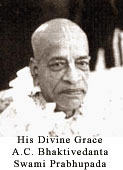
This Bhagavad-gita lecture was originally spoken
in New York, December 1, 1966 and later published in Back To
Godhead
magazine, Issue #15-05, 1980.
Comment
Send
this story to a friend  Printer
Friendly Page Printer
Friendly Page
satatam
kirtayanto mam
yatantash cha dridha-vratah
namasyantash cha mam bhaktya
nitya-yukta upasate
"Always chanting My glories, endeavoring with great determination,
bowing down before Me, the great souls perpetually worship Me with
devotion." [Bhagavad-gita 9.14]
Lord Krishna is
describing the mahatmas, or great souls, who worship the
Supreme Lord by the process of kirtana. Kirtana means
"chanting" or, more specifically, "describing.” You can describe with
music; you can describe in writing. You can describe in speeches. Any
sort of describing—that is called kirtana. Devotional service
to the Lord begins with kirtana and shravana, hearing.
Unless you hear, you cannot describe. What shall you describe? If you
do not know anything about the Supreme Lord, then how can you describe
Him? Therefore, hearing is the first item.
All Vedic literature is called shruti-shastra. Shruti
means "to receive through hearing." If you want to know the Supreme
Spirit, you do not need to qualify yourself materially. You can remain
what you are. But you must simply hear. God has given you the power of
hearing. If you hear about God from authoritative sources, you will
become perfect. Simply by hearing. Therefore, the first
principle—hearing—is essential.
Formerly, the Vedas were heard by students from their
spiritual master. For instance, in the Bhagavad-gita
you'll find that Arjuna was hearing from Krishna. On the
battlefield he was not studying any Vedanta philosophy. He was
simply hearing. You can hear at any place. Even on the battlefield, you
can hear from the authoritative source. So that has always been the
process of acquiring knowledge.
Hearing means receiving the knowledge—not manufacturing knowledge.
There are some persons who think, "Oh, why shall I hear from him? I can
think. I can speculate. I can manufacture something new in my own
circle of friends.” This is nonsense. This is not the Vedic process.
The Vedic process is hearing. There are two processes of acquiring
knowledge: the ascending process and the descending process. The
"ascending" way means trying to go high—trying to elevate yourself—by
your own strength. And the "descending" way means receiving pure
knowledge from someone who is already elevated, from someone who
already understands the Absolute Truth. So the ascending, or inductive,
process is not recommended as the Vedic process of knowledge. The Vedic
way of receiving knowledge is the descending, or deductive, process—the
student gives submissive aural reception to the bona fide spiritual
master. That is the way real knowledge comes to us.
As you have read in the Fourth Chapter of Bhagavad-gita, evam
parampara praptam imam rajarshayo viduh: traditionally this
knowledge of self-realization was imparted in this way-from spiritual
master to student. The Lord said, "I imparted this knowledge first of
all to the sun-god, Vivasvan, and the sun-god imparted this knowledge
to his son, Manu. And Manu imparted this knowledge to his son,
Ikshvaku." At that time Ikshvaku was the king of this planet. So from
Ikshvaku this knowledge is coming down-from father to son, or from
master to disciple.
And now, because that disciplic succession had been broken, Lord
Krishna was saying, "I am again speaking that old system of knowledge
to you, Arjuna—because you are My devotee, because you are My dear
friend." So this is the way. Hearing is the first stage. Hearing is so
powerful that simply by hearing from the authoritative source you can
become completely perfect—simply by hearing.
Submissive hearing, of course. Jnane prayasam udapasya namanta
eva. This is a verse from the Srimad
-Bhagavatam. "Don't be an upstart. Don't try to understand the
supreme knowledge, the Absolute Truth, by your own strength," Your
intelligence is limited; your senses are imperfect. You cannot
understand. This should be given up—
attempting to know the Supreme by the ascending process.
Nowadays, everyone is thinking, "Oh, I'll manufacture my own way. Why
shall I accept any authority? I shall decide myself what I am and what
is my duty." This is going on. But this is not the Vedic process. The
Vedic process is shravana, hearing from the bona fide source.
So if we simply give up this foolish process of trying to know the
Absolute Truth by our own efforts and become submissive, then we will
be successful on the path of enlightenment.
"Submissive" means—we must know our imperfection. As long as we are
conditioned, we are subject to four kinds of imperfection. First of
all, we must commit mistakes. As long as we are materially conditioned,
nobody can say, "I'll not commit a mistake; I never commit any
mistakes." It is not possible. You must. To err is human. So this is
one imperfection.
Second, we become illusioned. We accept as true that which is false.
For example, we identify with this body. If every one of us were asked
what we are—"Oh, I am American." But what is "American"? These bodies
are American. But we are not, because we are not these bodies. So this
is illusion.
Then, our senses are imperfect. We are very proud of seeing, but as
soon as the light is put off, we cannot see. So our seeing is
conditional. And similarly, all of our other senses are conditional.
Therefore they are imperfect.
And finally, we have got a cheating propensity. We do not know
anything, but we want to cheat others into thinking that we know
everything. I may be Fool Number One, but I want to start a group of
students and teach them foolish things. This is cheating.
One must learn the Absolute Truth from the authoritative sources and
then speak that knowledge to others. Arjuna was taught by Krishna, and
we are still speaking that same philosophy, even today. And those who
are following Arjuna's submissive attitude—they're the real students of
Bhagavad-gita.
So our attempt to understand the Absolute Truth by our faulty senses
and experience is futile. We must hear. That is the Vedic process.
Formerly the student would go to the home of the spiritual master,
which was known as the gurukula. Every brahmana, every
self-realized soul, every vipra (or expert in the knowledge of
the Vedic literatures) would be provided with some brahmacharis,
celibate students. They would follow the rules and regulations of
brahmachari life and live at the home of the spiritual master, and
he would teach them real knowledge from the Vedic literatures. That is
the process. So, one should not adopt the ascending process. Jnane
prayasam udapasya. Udapasya means, "Give it up.” and namanta
eva—"Be submissive.” Namanta eva jivanti san-mukharitam
bhavadiya-vartam: if one hears from the realized soul—just as
Arjuna heard from Krishna, the perfect person—then one will attain the
perfection of life without any difficulty.
One may also hear from Krishna's representative, the devotee of
Krishna. For instance, Arjuna was made the representative of Krishna.
Why? Krishna said, bhakto'si—"Because you are My
devotee." But nobody can become the representative of Krishna, or God,
without becoming His devotee. One who thinks, "I am God"—he cannot
become the representative of God.
Suppose you are a businessman and you send your representative for
securing business. Now, if the representative presents himself to the
customer, "I am the proprietor—I am the proprietor," how long can he go
on like this? As soon as the employer finds out that this foolish man
is presenting himself as the proprietor of the firm, at once he'll fire
the man. Because that man is cheating. He's not the proprietor.
Similarly, anyone who says, "I am God"—he should not teach.
Of course, one may think himself capable of acquiring knowledge of God.
That is another thing. "I am God" has to do with the quality of God.
Because I am part and parcel of God, I am qualitatively the same as God.
For example, even a molecular particle of gold is also gold. It is
nothing but gold. Similarly, although we are very minute fragments of
the Supreme, our quality is the same as His. So if I study myself, then
I can study God, also, because I can understand the quality of God. But
I may not understand the quantity.
Suppose you receive some good grains of rice. At first you are not
concerned with the quantity of rice in stock, but from the sample you
can understand the quality of the rice, and you can purchase. Then you
make your transaction: "How many pounds have you got in your stock that
I can take?" So quantity is another thing. But from the quality you can
make your selection of what sort of rice you shall purchase. In the
same way, you are qualitatively one with God—but quantitatively you are
different. God is great, and you are small.
Therefore you cannot claim, "I am God." Because if you advertise
yourself as God, then people may ask of you, "If you are God, then show
me your all-powerfulness," and that you cannot show. So you cannot
claim, "I am God'" As far as Krishna is concerned, He proved that He is
God. How? In the Bhagavad-gita. In the Eleventh Chapter
Arjuna requested, "O Krishna, will You kindly show me Your universal
form?" So Krishna showed him.
This was Arjuna's lasting message to the world: "In the future so many
fools will represent themselves as God. So don't be fooled by them.
Just ask them, ‘Show me your universal form.’ If they can do that, then
accept them as God. But don't very cheaply accept any fool as God."
This is the highest imperfection: someone is under the stringent laws
of material nature—if he simply gets a toothache he becomes
overwhelmed—yet he advertises himself as God. This sort of thing can be
accepted only by people of a similarly foolish nature. God is supreme.
Nobody else can be God, and nobody else can be equal with God.
In the Vedic literature, God is called asamordhva. Asama means,
"Nobody is equal to Him.” And urdhva means, "Nobody is higher
than Him." Nobody can be equal to God, and nobody can be higher than
God. Everyone is lower than God, however great one may be. There is a
nice verse in this connection: shiva-virinchi-nutam. Shiva
means Lord Shiva. And virinchi means Lord Brahma. They are
considered to be the topmost demigods in this material world. But they
also offer their respectful obeisances to Vishnu, or God. So nobody can
be equal to God. Therefore, instead of trying to become God, or instead
of trying to understand God personally by our tiny knowledge and
imperfect senses, we would do better to become submissive. Jnane
prayasam udapasya: "Just give up this foolish habit of thinking,
'I can know God by speculation. Just become submissive, and try to hear
from bona fide authorities."
Who is the authority? Krishna—God—or His representative, like Lord
Jesus Christ. Christ is a representative of God. So he's an authority.
And similarly with any other authorized incarnation. That incarnation
will never say, "I am God." Rather, "I am a servant of God." That is
his credential for representing God. He'll never say, "I am God." He'll
say, "I am a servant of God" or "I am a son of God" or "I am a devotee
of God." He's a real representative.
So we have to hear from him submissively, sthane sthitah.
Sthane sthitah means "keeping oneself in one's
position." For instance, you are hearing Bhagavad-gita.
Some of you are medical men. Some of you are engineers. Some of you are
businessmen. Some of you are clerks. That doesn't matter. You can
remain in your occupational position. You remain an American. You
remain a Christian. It doesn't matter. But there is no harm in hearing
Bhagavad-gita. There is no harm. You'll get knowledge—you'll get
knowledge. You'll become a better Christian. You'll become a better
American. You see? We are not trying to convert Americans into Indians,
or Indians into Americans, or Christians into Hindus. That is not our
mission. We are just teaching the science of Krishna, the science of
God, Krishna consciousness.
So everyone can learn this science. For example, when you go to
college, there is no question of whether a man is American or Indian or
African. Everyone in the school or college or university is allowed to
receive scientific knowledge. So this is Krishna consciousness, the
science of God. Everyone can take part. Sthane sthitah—there
is no need of change. Shruti-gatam tanu-van-manobhir:
just try to assimilate the knowledge with your body, with your mind,
and with your intelligence.
If you do this, then the result will be prayasho ‘jita jito ‘py
asi tais tri-lokyam: you will conquer the unconquerable Lord.
Another name for God is Ajita. Ajita means "unconquerable.”
Because, after all, everyone is lower than God. Who will conquer Him?
What to speak of God-we cannot conquer even the energy of God. We are
all under the influence of the material energy of God in our present
conditioned life. We cannot conquer even the energy. So how can we
conquer God? It is not possible. So therefore another name of God is
Ajita, or "one who is unconquerable." But that unconquerable person
sometimes becomes conquered. How? By this process of submissively
hearing about God and trying to assimilate the knowledge nicely. That's
all.
God is neither Christian nor Hindu nor Muslim nor anything else. God is
God. If you hear Bhagavad-gita submissively and try to
apply it with your body, mind, and intelligence, then you'll understand
God so nicely that although God is unconquerable, you'll conquer Him.
You'll conquer Him. By this simple process. This is why shravana
—hearing—is so important, and why in devotional service the first step
is hearing. Then whatever you learn, if you describe it, that will help
you to elevate yourself on this path of knowledge. Whatever we have
discussed here today—if you have heard it in the proper consciousness,
and if you try to repeat it amongst your friends and your family
members
—then you'll be established in this knowledge. That is called kirtana,
describing. Shravanam kirtanam: hearing and describing.
Every day and night we are hearing something. There is television.
There is radio. There are newspapers. There are so many things to hear
about. But that is not the hearing that will help us to become
self-realized. Shravanam kirtanam vishnoh. You should
devote your time to hearing and chanting about Vishnu, Krishna. Krishna-kirtanam.
Kirtanad eva krishnasya mukta-sangah param vrajet.
If you simply do this—hear and chant about Krishna—then you shall
become free from this material entanglement, and you shall be elevated
to the supreme place, the kingdom of God. Hearing and chanting-this is
the remedy suggested in this age. You cannot successfully practice
anything else. You cannot practice sacrifice. You cannot practice
speculation. You cannot practice mystic yoga. Nothing. You can
simply practice this: submissively hear the science of Krishna from
authoritative sources. Try to assimilate it. And become perfect.
|

Sri Guru and Gauranga
Related Articles
Who is the
Author
Professional
Holy Men
Learn by
Hearing, Not by Reading
No
One Can Save Himself, No Matter How Hard He Tries
Spiritual Master
and the Disciple
The Point
of Visiting the Holy Places
The
Absolute Necessity of a Spiritual Master - The Universal Teacher
Related Topics
Knowledge -
Enlightenment
Krishna Consciousness,
the Process
Spiritual
Master -
Rittvik - Initiation
Vedas - Vedic Authority
Back to Top
Back to Top
Back to Top
Back to Top
Back to Top
Back to Top |
