 Krishna Books What is Hare Krishna? The Founder-Acharya Hare Krishna Mantra Sankirtan Movement Personality of Godhead Lord Chaitanya A.C.Bhaktivedanta Swami Prabhupada Hansadutta das Events: Kirtan Festival World Sankirtan Party Submit News © 2004 - Hansadutta das |
[Posted April 28, 2007]
No
Avoiding Danger—Green Zone an illusion
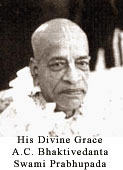
A.C. Bhaktivedanta Swami |


|
Predictions
|
Who will Win? Hansadutta das Recently, a United States Military General commented at a news conference: "The insurgents cannot win." But even if the insurgents do not fire another shot, how will you win? You will die without any insurgent making any other effort, so what is "win"? You will "win" what? The Americans will all die, even if they "win". The insurgents will also die, without any effort on the part of the Americans. Everyone will die, without any effort being expended by either Americans, Iraqis, insurgents, Communists, Muslims, etc. So what is the meaning of the General's statement: "The insurgents will not win"? Who will win? If everyone is certain to die, either today, tomorrow, or after some years, who is going to win? What is the meaning of "win"? Win what? Who will win? If all are destined to die, now or later, who will win? What does "win" mean? Win what? If you are killed by a bullet or a brain tumor, what is the difference? This is the real question: who will win? more |
[Queen Kunti said:] "I wish that all those calamities would happen again and again so that we could see You again and again, for seeing You means that we will no longer see repeated births and deaths.—Srimad-Bhagavatam 1.8.25
PURPORT
Generally, the distressed, the needy, the intelligent, and the
inquisitive who have performed some pious activities worship or begin
to worship the Lord. Others, who are thriving on misdeeds only,
regardless of status, cannot approach the Supreme due to being misled
by the illusory energy. Therefore, for a pious person, if there is some
calamity there is no other alternative than to take shelter of the
lotus feet of the Lord. Constantly remembering the lotus feet of the
Lord means preparing for liberation from birth and death. Therefore,
even though there are so-called calamities, they are welcome because
they give us an opportunity to remember the Lord, which means
liberation.
One who has taken shelter of the lotus feet of the Lord, which are
accepted as the most suitable boat for crossing the ocean of nescience,
can achieve liberation as easily as one leaps over the holes made by
the hooves of a calf. Such persons are meant to reside in the abode of
the Lord, and they have nothing to do with a place where there is
danger in every step.
This material world is certified by the Lord in the Bhagavad-gita
as a dangerous place full of calamities. Less intelligent persons
prepare plans to adjust to those calamities, without knowing that the
nature of this place is to be full of calamities. They have no
information of the abode of the Lord, which is full of bliss and
without trace of calamity. The duty of the sane person, therefore, is
to be undisturbed by worldly calamities, which are sure to happen in
all circumstances. Suffering all sorts of unavoidable misfortunes, one
should make progress in spiritual realization, because that is the
mission of human life. The spirit soul is transcendental to all
material calamities; therefore, the so-called calamities are called
false. A man may see a tiger swallowing him in a dream, and he may cry
for this calamity. Actually there is no tiger and there is no
suffering; it is simply a case of dreams. In the same way, all
calamities of life are said to be dreams. If someone is lucky enough to
get in contact with the Lord by devotional service, it is all gain.
Contact with the Lord by any one of the nine devotional services is
always a forward step on the path going back to Godhead.
In this very interesting verse, it is described that vipadah—calamities
or dangers—are very good if such dangers and calamities remind us of
Krishna.
tat te 'nukampam susamikshamano
bhuñjana evatma-kritam vipakam (SB 10.14.8)[1]
How
does a devotee receive dangers? There must be dangers because this
material world is full of dangers. But foolish people who do not know
this try to avoid the dangers. Thus they struggle for existence.
Everyone is trying to become happy and avoid danger. This is our
material business. Everyone is trying for atyantikam sukham,
ultimate happiness. A working man thinks, "Let me work very hard now
and put money in the bank, so that when I get old I shall enjoy life
without working." This is the inner intention of everyone. No one wants
to work; as soon as one gets some money, he wants to retire from work
and become happy. But that is not possible. One cannot become happy in
that way.
Here Kuntidevi speaks of apunar bhava-darshanam [SB
1.8.25]. The prefix a means "not," and punar bhava
means "repetition of birth and death." The real danger is the
repetition of birth and death. That must be stopped.
The material world is full of dangers (padam padam yad vipadam
[SB 10.14.58]). For example, if one is on the ocean one may have a very
strong ship, but that ship can never be safe; because one is at sea, at
any time there may be dangers. The Titanic was safe, but on its first
voyage it sank, and many important men lost their lives. So danger
there must be, because we are in a dangerous position. This material
world itself is dangerous. Therefore, our business now should be to
cross over this sea of danger as soon as possible. As long as we are at
sea, we are in a dangerous position, however strong our ship may be.
That's a fact. But we should not be disturbed by the sea waves;
instead, we should just try to cross over the sea and get to the other
side. That should be our business.
As long as we are in this material world, there must be calamities
because this is the place of calamity. But even with calamities our
business should be to develop our Krishna consciousness, so that after
giving up this body we may go back home, back to Krishna.
On the Battlefield of Kurukshetra, Arjuna said to Krishna, "Whatever
You are saying is all right. I am not this body. I am a soul, and this
is also true of everyone else. So when the body is annihilated, the
soul will continue to exist. But when I see that my son is dying or my
grandfather is dying and that I am killing, how can I be solaced simply
by knowing that they are not dying, but that only their bodies are
changing? I am accustomed to thinking of them with affection in terms
of the body, and so there must be grief and suffering."
Krishna did not deny what Arjuna said. "Yes," He replied. "That's a
fact. Because you are in the bodily concept of life, there must be
suffering. So you must tolerate it, that's all. There is no other
remedy." As mentioned in Bhagavad-gita (2.14), Lord
Krishna told Arjuna:
matra-sparshas tu kaunteya
shitoshna-sukha-duhkha-dah
agamapayino 'nityas
tams titikshasva bharata
"O son of Kunti, the nonpermanent appearance of heat and cold, happiness and distress, and their disappearance in due course, are like the appearance and disappearance of winter and summer seasons. They arise from sense perception, O scion of Bharata, and one must learn to tolerate them without being disturbed."
In
America it may sometimes be very chilly in the morning, and that may
make taking one's morning bath a little difficult. But does that mean
that those who are devotees will stop taking their prescribed morning
bath? No. Even if it is chilly, they must take this regular bath. The
duty must be done, even if there is a little suffering involved. That
is called tapasya, or austerity. Tapasya means that we
must proceed with our business of Krishna consciousness despite all the
dangers and calamities of this world. This is called tapasya,
or voluntary acceptance of the difficulties of life.
Sometimes those who have undertaken strict vows of tapasya will
ignite a ring of fire all around themselves, and in the scorching heat
of the sun in the hot summer they will sit down in the midst of that
fire and meditate. Similarly, in the chilly cold of winter they will
immerse themselves in water up to the neck and meditate. Such vows are
prescribed in strict systems of tapasya. But Lord Chaitanya
Mahaprabhu does not give us such a prescription. Instead, He gives us a
very nice program: chant, dance, and take prasada—food offered
first to Lord Krishna. But still we are unwilling. We are so fallen
that we cannot accept even this tapasya. Although this kind of tapasya
is very easy to perform and very pleasant (su-sukham kartum
avyayam [Bg. 9.2]), still we are not agreeable. We may even
prefer to rot in the street. Some people prefer to drink and have sex
and live in the street. So what can be done?
The Krishna consciousness movement is giving all facilities so that
people may come here, chant, dance, live very peacefully, take krishna-prasada,
and be happy, but people will not accept it. That is called misfortune.
Chaitanya Mahaprabhu, portraying the people of this age, therefore
said, "I am so unfortunate that I have no attachment for chanting Hare
Krishna." Lord Chaitanya prayed (Shikshashtaka 2):
namnam akari bahudha nija-sarva-shakti
statrarpita niyamitah smarane na kalahe
tadrishi tava kripa bhagavan mamapi
durdaivam idrisham ihajani nanuragah
Krishna,
the transcendental holy name of God, has all potencies, Lord Chaitanya
said. Krishna has unlimited potencies, and similarly in the holy name
of Krishna there are unlimited potencies. Krishna has thousands and
thousands of names, of which the name Krishna is the chief, and there
are no hard and fast rules for chanting. It is not that one must chant
at a certain time. No. At any time one may chant. Furthermore,
Krishna's name is identical with Krishna Himself. Therefore the holy
name of Krishna is Krishna.
We should not think that Krishna is living in His abode, Goloka
Vrindavana, and that His name is different from Him. In the material
world, of course, in the material conception, a name is different from
the fact it represents. But in the absolute world there are no such
differences. The name is as potent as Krishna is. We have a tongue, and
if we use this tongue to chant Hare Krishna, we shall immediately come
directly in touch with Krishna, because the name Krishna and the person
Krishna are not different. We may think that Krishna is far, far away,
but in fact Krishna is within us. He is far away, but at the same time
He is the nearest. But even if we think that Krishna is far, far away,
His name is present. We can chant Hare Krishna, and Krishna will
immediately become available. Krishna is available in this easy way,
for which there are no hard and fast rules. We can chant at any time
and immediately get Krishna. Just see the mercy of Krishna!
Therefore Chaitanya Mahaprabhu says, etadrishi tava kripa
bhagavan mamapi durdaivam idrisham ihajani nanuragah: "My dear
Lord, You
have given me such generous facilities by which to contact You, but I
am so unfortunate that I have no attachment for these things. I have
attachment for so many other things, but I have no attachment for
chanting Hare Krishna. This is my misfortune." Krishna is so
magnanimous that He is present before us by the transcendental
vibration of His name, which has all the potencies of Krishna Himself,
and if we remain in contact with that name we shall get all the
benefits of Krishna's benedictions. But still we are not inclined to
chant the Hare Krishna mantra. This is our misfortune.
A devotee, however, is never disturbed by dangers, reverses, or
calamities. Rather, he welcomes them. Because he is a surrendered soul,
he knows that both dangers and festivals are but different
demonstrations of Krishna, who is absolute. In the shastra, the
Vedic literature, it is said that religion and irreligion, which are
complete opposites, are merely the front portion and the back portion
of God. But is there any difference between God's front and God's back?
God is absolute, and therefore a devotee, either in opulence or in
danger, is undisturbed, knowing that both of these are Krishna.
When a devotee is in danger, he thinks, "Now Krishna has appeared
before me as danger." In His form of Nrisimhadeva, the Lord was
dangerous to the demon Hiranyakashipu, but the same Nrisimhadeva was
the supreme friend to the devoted Prahlada Maharaja. God is never
dangerous to the devotee, and the devotee is never afraid of dangers,
because he is confident that the danger is but another feature of God.
"Why should I be afraid?" the devotee thinks. "I am surrendered to Him."
Therefore Kuntidevi says, vipadah santu: "Let there be
calamities." Vipadah santu tah shashvat: "Let all those
calamities happen again and again." Because she knows how to remember
Krishna at times of danger, she is welcoming danger. "My dear Lord,"
she says, "I welcome dangers, because when dangers come I can remember
You." When Prahlada Maharaja's father was putting him into dangerous
predicaments, Prahlada was always thinking of Krishna. So if we are put
into a dangerous position and that danger gives us an impetus to
remember Krishna, that is welcome: "Oh, I am getting this opportunity
to remember Krishna." Why is this welcome? It is welcome because seeing
Krishna or remembering Krishna means advancing in spiritual life so
that we will not have to suffer any more of these dangers. Tyaktva
deham punar janma naiti mam eti so 'rjuna (Bg. 4.9). If one
becomes advanced in Krishna consciousness, the result will be that
after giving up the body (tyaktva deham) one will not have to
take birth again in this material world (punar janma naiti).
This is to be desired.
Suppose I am very comfortable at the present moment. My body may be
comfortable, but there will be death, and then another birth. After
giving up my present body, if I get the body of a cat or a dog, what is
the meaning of my comfortable position? Death is sure, and after death
one must surely accept another body. We may not know what kind of body
we shall get, but we can know from the shastra, the Vedic
literature. The shastra says that according to our particular
mentality, we will get a particular kind of body. Although I may be in
a comfortable position, if I keep myself in the mentality of a dog, I
shall get my next life as a dog. Therefore, what is the value of this
comfortable position? I may be in a comfortable position for twenty
years, thirty years, fifty years, or at the utmost one hundred years.
Yet if, when I give up this body, my mentality causes me to become a
cat, a dog, or a mouse, what is the benefit of this comfortable
position? But people do not consider this. They think, especially in
the present age, "I am now in a comfortable position. I have enough
money and a good estate. I have ample comforts and enough food. When
this body is finished, I am not going to take birth again, so as long
as I am living, let me enjoy life." This is the modern philosophy of
hedonism, but it does not correspond to the facts.
Kunti, however, is aware of birth and death, and she is anxious not to
repeat this process. This is indicated by the words apunar
bhava-darshanam [SB 1.8.25]. If one always sees Krishna, one is
in Krishna consciousness, for Krishna consciousness means always
thinking of Krishna. One's consciousness should be absorbed in Krishna
thought. Therefore the spiritual master gives different varieties of
engagements to devotees in Krishna consciousness. For example, under
the direction of the spiritual master the devotees may sell books in
Krishna consciousness. But if the devotees think that the energy
invested in selling books should be diverted into selling jewelry, that
is not a very good idea. Then they would become nothing more than
jewelers. We should be very much careful not to be diverted from
Krishna consciousness. Even if there is danger or suffering in Krishna
consciousness, we should tolerate it. We should even welcome such
danger, and we should pray in appreciation to Krishna.
How should we pray? Tat te 'nukampam susamikshamanah: [SB
10.14.8] "My dear Lord, it is Your great mercy that I have been put
into this dangerous position." That is the viewpoint of a devotee. He
doesn't regard danger as danger. Rather, he thinks, "It is Krishna's
mercy." What kind of mercy? Bhuñjana evatma-kritam
vipakam: "Because of my past activities, I was meant to suffer
very much. But You are mitigating that suffering and giving me only a
little." In other words, by the grace of Krishna a devotee may receive
only token punishment.
In court an important man is sometimes found to be a culprit, and the
judge may be able to fine him a hundred thousand dollars and know that
the man can pay it. But he may tell the man, "You just give one cent."
That is also punishment, but it is greatly minimized. Similarly, we
have to suffer for our past deeds. That is a fact, and we cannot avoid
it. But karmani nirdahati kintu cha bhakti-bhajam (Brahma-samhita
5.54): the sufferings of those who engage in devotional service in
Krishna consciousness are minimized. For example, one may have been
destined to be killed, but instead of being killed with a knife, he may
instead get some little cut on his finger. In this way, for those who
engage in devotional service, the reactions of past activities are
minimized. Lord Krishna assures His devotees,
aham tvam sarva-papebhyo mokshayishyami: [Bg. 18.66] "I shall
give you protection from the reactions of sinful life." So even if a
devotee has a history of very grievous criminal activities behind him,
instead of being killed he may only get a little cut on his finger. Why
then should a devotee fear danger?
We should simply depend on Krishna consciousness, because if we live
Krishna consciously under all circumstances, we shall not return to
this material world (apunar bhava-darshanam [SB 1.8.25]).
If we repeatedly think of Krishna, see Krishna, read of Krishna, work
for Krishna, and somehow or other remain in Krishna consciousness, we
benefit in such a way that we shall be saved from taking birth again in
the material world. That is true benefit. But if we become a little
comfortable because of other, materialistic engagements and we forget
Krishna and have to take birth again, then what is our benefit? We
should be very careful about this. We should act in such a way that our
Krishna consciousness can under no circumstances be disturbed, even if
there is heavy suffering. That is the instruction of Kuntidevi.
Before winning the Battle of Kurukshetra, all the Pandavas were
put into many dangers, as already described in the previous verses.
They were given poison, they were put into a house of lac that was
later set afire, and sometimes they were even confronted with great
man-eating demons. They lost their kingdom, they lost their wife, they
lost their prestige, and they were exiled to the forest. But throughout
all those dangers, Krishna was there. When the Kauravas were trying to
strip Draupadi naked, Krishna was there supplying cloth to protect her
honor. Krishna was always there.
Therefore, when the Pandavas went to see their grandfather,
Bhishmadeva, on his deathbed, Bhishmadeva began to cry. "These boys, my
grandsons, are all very pious," he said. "Maharaja Yudhishthira, the
oldest of the brothers, is the most pious person. He is even called
Dharmaraja, the king of religion. Bhima and Arjuna are both devotees,
and they are such powerful heroes that they can kill thousands of men.
Their wife, Draupadi, is directly the goddess of fortune, and it has
been enjoined that wherever she is, there will be no scarcity of food.
Thus they all form a wonderful combination, and moreover, Lord Krishna
is always with them. But still they are suffering." Thus he began to
cry, saying, "I do not know what is Krishna's arrangement, because such
pious devotees are also suffering."
Therefore, we should not think, "Because I have become a devotee, there
will be no danger or suffering." Prahlada Maharaja suffered greatly,
and so did other devotees like the Pandavas and Haridasa Thakura. But
we should not be disturbed by such sufferings. We must
have firm faith, firm conviction, knowing, "Krishna is present, and He
will give me protection." Don't try to take the benefit of any shelter
other than Krishna. Always take to Krishna.
In Bhagavad-gita Lord Krishna says, kaunteya
pratijanihi na me bhaktah pranashyati: [Bg. 9.31] "My dear
Arjuna, you may declare to the world that My devotee is never
vanquished." Now, one may ask, why did Krishna advise Arjuna to declare
this? Why did He not declare it Himself? The answer is that if Krishna
Himself made this declaration, it might be suspect, because Krishna
sometimes violates His own promise. But the promise of a devotee will
never be violated. This is Krishna's concern. "Oh, My devotee has
declared this. I must see that his word is kept." This is Krishna's
position because of His affection for His devotee. Therefore Lord
Krishna said, "You declare it. If I declare it, people may not believe
it, but if you declare it they will believe you because you are a
devotee." Even though Krishna may break His own promise, He wants to
see that the promises of His devotees are fulfilled.
Therefore, we must take to Krishna consciousness and adhere to this
consciousness under all circumstances, even in the most dangerous
position. We must keep our faith in Krishna's lotus feet, and then
there will be no danger.
1. "My dear Lord, one who earnestly waits for You to bestow Your causeless mercy upon him, all the while patiently suffering the reactions of his past misdeeds and offering You respectful obeisances with his heart, words and body, is surely eligible for liberation, for it has become his rightful claim." - Srimad-Bhagavatam 10.14.8 [back to text]
No Avoiding Danger—Green Zone an illusion/ WORLD SANKIRTAN PARTY ©2007 - Hansadutta das
Home | About | Events | World Sankirtan Party | Inside Nam Hatta
eBooks | Site Map | Store

Sri Guru and Gauranga
Related Articles
Phantasmagoria
World of Terror
Who will Win?
Poignant Reminder: Nobody's Safe
Send the President to Iraq
Related Topics
World Community - Government, Economy, Politics
Back to Top
Back to Top
Back to Top
Back to Top
Back to Top
Back to Top
Back to Top
Back to Top
Back to Top