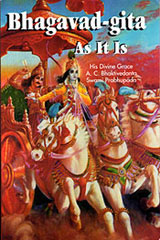
Bhagavad-gita
As It Is by A.C. Bhaktivedanta Swami
Unabridged, unrevised reprint of the 1972 MacMillans ed. $14.95 Buy it now.
[Posted June
6, 2007]
Checking
In to Check Out
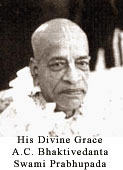
His Divine Grace A.C.
Bhaktivedanta Swami Prabhupada
Reuters
- June 5, 2007 - JONATHAN ALLEN
At an Indian hotel, guests check in to die VARANASI, India (Reuters) - After checking in at the Mukti
Bhawan hostel, guests have two weeks to die or else they are gently
asked to leave.
The hostel -- a short walk from the Ganges river in the northern Indian
city of Varanasi -- is a final stopover for elderly Hindus hoping they
will shortly end up on one of the hundreds of funeral pyres lit on the
riverbank each day.
"While the rest of the world celebrates a new life when a child is
born, similarly we celebrate death," said Bhairav Nath Shukla, the
cheerful manager of Mukti Bhawan, one of several places offering
shelter to outsiders wanting to die in the city.
Hindus believe that dying in Varanasi and having their remains
scattered in the Ganges allows their soul to escape a cycle of death
and rebirth, attaining "moksha" or salvation. go
to story
Maya
is so strong that even though this experience takes place not only in
the human form of life but at every moment in all species of life, we
still continue to act in the bodily concept of life. Our father has
died, his father died. Now we are fathers, and we too shall die. Our
children will become fathers, and they also will die. Still, we are
stuck on this mistaken concept of life. We are working day and night to
maintain the body by earning money for sense gratification. This is maya,
and the whole material creation is under the spell of this maya.
more
Now
the history of Srimad-Bhagavatam is like this, that
Parikshit Maharaja was a great king, emperor of the world, very pious
devotee, all qualified. So sometimes he went to the forest for hunting.
The hunting is allowed to the kshatriyas, kings, royal kings.
Why? Because a king has to look after administration of the society;
therefore sometimes he has to order to kill some men—"Hang this man."
Or sometimes he will take the sword in his own hand and kill the
culprit, criminal, immediately. So therefore the killing practice was
allowed to the kshatriyas, royal family. Therefore sometimes
the king would go into the forest and kill some animals to practice.
Just like in the medical laboratory, physiological laboratory, some
animals are tested to see the physiological condition of the body,
similarly, always these experiments are made on the animals. So
Maharaja Parikshit went to the forest for hunting. So he was very
tired. He was very tired, and he entered the cottage of one hermit. He
was at that time in meditation. So Parikshit Maharaja was very much
thirsty and hungry, and because he was king, he can order anyone, royal
order, so he entered the cottage and asked the hermit, that muni,
that "Please give me something to eat. I am very hungry," or "Give me
some drinking water." But he was in meditation. By chance he could not
hear Maharaja Parikshit. He was silent. But because he was king, king,
royal power, he little became agitated, although he was very nice king:
"Oh, he is disordering, er, disobeying my orders?" Then he became
disgusted. And there was a dead serpent lying there. So he took that
dead serpent and put it on the neck of the hermit and went away.
Now, that hermit had one boy, a ten years, twelve years old, and that
boy had some playmates. They were playing, and some of the boys
informed the son of that hermit: "Your father has been insulted by the
king. He is garlanded with a dead snake." So that boy, the son of that
hermit became very angry, and he cursed him. That one point is here to
see, that a child of a brahmana, a son of a brahmana,
was so powerful that he could curse a great king like Maharaja
Parikshit: "You have insulted my father, so that snake will bite you
within seven days, and you will die." This was the version. Now the boy
came back home and saw the father was garlanded with the dead snake,
and he began to cry, began to cry. He felt so much that his father was
insulted. His father was brahmana. He was brahmana.
"Oh, brahmana has been insulted by the kshatriya?" So
he felt too much. He began to cry. So by his crying, that hermit came
to his senses and asked the boy, "Why you are crying?" "Oh, father, you
do not know. You have been insulted by the king in this way, and I have
cursed him." Oh, his father became astonished. "Oh, you have cursed
Maharaja Parikshit? Oh, you have done the greatest blunder. Oh, such a
nice king. Depending on him, the subject, the citizens, are sleeping
very peacefully. There is no danger. And you have cursed him?" Oh, he
became very much sorry. And that description is there. Next day we
shall explain how he was sorry. But after all, the cursing was already
there.
So he sent information to the king that "My dear king, this accident is
already done. So you prepare yourself for death." That information was
given. So Parikshit Maharaja was also very sorry, that "I insulted a brahmana,
which I should not have done," and he welcomed the cursing, that "It is
good for me that I have been cursed, so that in future I shall not dare
to act like that." He was such a nice king. Anyway, he was young man.
He was not old man. He was within thirties. So immediately he entrusted
the whole kingdom to his young boy, and he left home, left home and
went to the Ganges side. The kingdom of Maharaja Parikshit was supposed
to be situated somewhere in New Delhi, and there is a river called
Yamuna. So Yamuna, Ganges, practically it is coming out from the same
source. That is according to Jiva Gosvami. But Yamuna is supposed to be
more sacred than the Ganges, because in the Yamuna Lord Krishna
enjoyed. So in the Srimad-Bhagavatam it is stated that
Maharaja Parikshit went to the bank of the Ganges. But near New Delhi
side there is no Ganges; there is Yamuna. So it is to be taken that he
went to the side of the Yamuna. Anyway, the news spread all over the
world that "The great king has been cursed, and he is going to die
within seven days."
So all great sages, saintly persons, scholars, kings, they went to see
him at the Ganges side. There was great assembly. And Parikshit
Maharaja inquired from everyone that "Now it is settled that I am going
to die. The time is fixed already. Within a week, I shall be dying. Now
what is my duty?"
The thing is that before death we must prepare ourself. The present
nonsense civilization, they don't prepare. They simply accept the flash
life as all in all. The other day I was corresponding with one
gentleman in London, Mr. Webb[?]. He is little atheistic. He said that
"There is no life, next. Just like a flower. A flower is bloomed and
finished." So I have replied that "No, it is not finished. How it can
be finished? The seed of the flower remains." Seed of the flower
remains. So, so long the seed of the flower will remain, there will be
many thousands and millions of manifestation of the flower. Similarly,
this body may be finished, but the seed of the body, the soul, that is
eternal. It will develop another body. That is a fact. Just like in
this very life every one of us experiencing that because I am the seed
of this body... Seed. Just try to understand this word seed. Just like
you have got idea: a small seed of a banyan tree. It is smaller than
even a mustard grain, but in that seed there is potency of a big tree,
so high, hundred stories high. In your country I see so many big trees
very high. There are many other big trees in other planets. So..., but
that big tree means that seed. Within that seed, there is so much
potency. That we do not understand. Actually, the materialist
scientists, they cannot produce such seed. That if you want the tree,
you have to sow one seed. If you have to produce a child, you have to
sow. The man has to sow the seed in the womb of the woman. This is a
practical.
So the seed is eternal. That we get information from Vedic literatures.
Bijo 'ham sarva-bhutanam [Bhagavad-gita
7.10]. Na hanyate hanyamane sharire [Bg. 2.20]. That bija,
that seed, does not, I mean to say, annihilate because the body is
annihilated. This is the basic principle of understanding for making
progress in spiritual life. One who does not understand this basic
principle, that the spirit soul, the seed, is eternal, and it is
transmigrating different bodies... And factually we know that "My
father gave the seed in the womb of my mother, that seed. And from that
seed developed this body. But I am... When my body was just like, as
small, just like a pea, I was there. And I have become so big. I am
there. So many bodily changes have taken place, but I am there."
Similarly, tatha dehantara-praptir dhiras tatra na muhyati
[Bg. 2.13]. Similarly, when we change this body finally and take
another body, so one who knows the fact or the science of birth and
death, he is not disturbed. He is not disturbed. Dhiras tatra na
muhyati. Dhira means intelligent, cool-headed, not
rascal. So this very word is used, dhira. Dhira means
cool-headed, not disturbed. Na muhyati: "He is not bewildered."
He's just changing this body. So now the business is that before
changing this body, "What kind of other body I am going to get?" That
is my business. That we can get according to as I deserve. Just like as
you educate yourself in your childhood, so you get a particular type of
post when you are businessman or working man. If you have got
sufficient education, you could get good post, good salary. And if you
are a nonsense, then you have to work like ordinary man, no good post.
Just we have got, we get different types of post according to our
culture or education, similarly this body, this human body, is the
preparation ground for the next type of body. If you neglect that, then
we are getting..., we are taking the risk.
Parikshit Maharaja, he was not a fool. He was a learned king. So all
the great sages and saintly persons assembled there. He asked them, "My
dear sirs, you are so kind that you have come here at the time of my
death. So kindly let me know what is my duty at the present moment." So
there were different kinds of authorities. Different kinds of
authorities means some were in favor of fruitive activities, karma-kanda,
pious activities; some were in favor of yoga principles; some
were in favor of philosophical speculation; and some were in favor of
devotional service of bhakti. So fortunately, Shukadeva
Gosvami—a boy of sixteen years old, though he was highly elevated in
spiritual knowledge, the son of Vyasadeva—he was wandering all over the
world, naked and without any care for his body or social convention. Of
course, he did not come into the cities, but he heard that Parikshit
Maharaja was going to die. "He is in need of some spiritual
instruction." So he also came there to that meeting. And when he was
coming, because he was a naked boy, sixteen-years-old boy, the street
boys were throwing stones upon him. But when he entered the assembly,
everyone stood up. Then the rascal creatures who were annoying him,
they fled away: "Oh, he is important man, that so many sages and
saintly persons have stood up." Anyway, when he reached there,
Parikshit Maharaja received him: "It is my good fortune that at this
time you have come, because it is very rarely you go to anyone's house,
but Krishna has sent you. Now what is my duty?" Parikshit Maharaja was,
from the very beginning... because the whole family, Pandava family,
they were devotees of Lord Krishna, so naturally he was devotee of Lord
Krishna. And when he was child, he was playing with the doll of
Krishna. These are described here. So he asked, "What is my duty? Shall
I continue my talks on Krishna, because naturally I am inclined to
Krishna? So what is your advice?"
So in answer to that, Shukadeva Gosvami spoke. Now, one thing we should
note in this connection, that Parikshit Maharaja, he was a powerful
king. He was equipped with all, everything, but he did not counteract
the curse. He could counteract that curse—he was so powerful, but he
accepted: "All right. I am cursed. I shall give up my life within seven
days." That means he took it as an opportunity that "I am going to
death within seven days. That is certain. And I must prepare myself
fully so that my next life I can approach Krishna. So this is a good
opportunity, that I have got seven days time."
We haven't got seven seconds time. We do not know. Nobody has served me
notice. We find by practical experience that we are walking on the
street—all of a sudden there is some accident, and we die. There is
possibility. So the important point is that Maharaja Parikshit was
fortunate enough to get seven days time before his death. But we do not
know how much time is there for our death. So how much serious we shall
be. Chanakya Pandit says, "If you want to make spiritual advancement,
then you should always think that death is next moment." Death is next
moment. Because there is no guarantee when death is coming. If I think
that death is next moment, that is not any utopian. The next moment may
be my death. And Chanakya Pandit says, "But if you want to be
materially happy, you should always think that 'I shall never die,'"
although it is false idea. Everyone will die.
So Parikshit Maharaja, he was preparing. How he was preparing? He did
not take seven days even a drop of water. He sat down tight on the bank
of the Ganges, and Shukadeva Gosvami narrated this Srimad-Bhagavatam,
and he heard, and at the end of seven days, at the particular time, he
was bitten by a snake and he left this world.
Now, the beginning of the Second Canto of Srimad-Bhagavatam
is the answer, sri-shuka uvaca: "Sri Shukadeva Gosvami
said." Because in the previous chapter the questions were put by
Maharaja Parikshit: "What is my duty?" So he says... Because he wanted
to know about Krishna, so Shukadeva Gosvami is approving his very nice prashna,
question:
"My
dear King Parikshit, you have put very nice question. And to hear about
Krishna is the topmost subject of hearing." Shrotavyadishu yah
parah. Parah means topmost, the highest. "So your
question, whether to hear about Krishna, is welcome." Variyan
esha te prashnah krito loka-hitam nripa: [SB 2.1.1] "This prashna,
this question, is very much beneficial to the people in general," loka-hitam.
Because Parikshit Maharaja was questioning, and Shukadeva Gosvami was
answering, but there were many other persons. Although the questions
and answers were only for Parikshit Maharaja, not for others, but
everyone expected that because Shukadeva Gosvami was speaking to the
king, that speaking must be very important to everyone. So all the
great sages... Even the father of Shukadeva Gosvami, Vyasadeva, who is
the compiler of so many Vedic literatures, he also came there to hear
his sixteen-years-old boy. He was so elevated. It does not matter
whether a man is old or young; it is the question of knowledge. So
Shukadeva Gosvami was so elevated that so many persons assembled there.
And the Suta Gosvami, who spoke the Srimad-Bhagavatam for
the second time amongst the sages of Naimisharanya, he was also present
in that meeting, and he heard from Shukadeva Gosvami, and he repeated
to the sages of Naimisharanya. So shri-krishna-shravanadhi-prayena
parama-prashna krita esha tu variyan. Shukadeva Gosvami is
congratulating Maharaja Parikshit, that "You have raised the question
of Krishna, understanding Krishna. It is very welcome." Yah
prashno 'pi shrotavyadishu param: "Such kind of question is the
topmost question, topmost question. There is no more better question
than this." In other words, when you become inquisitive to understand
the Krishna consciousness, then that very questions will elevate you to
the highest perfectional stage.
So, shrotavyadishu yah para, yasya prashna syapi shravanadau
paramah purusharthah. Now, Shukadeva Gosvami says that "The
question put by you and the answers which I shall give to you, even the
general persons who are assembled here, they do not understand it
rightly, but simply hearing that mantra, or the answers, will
give them the highest quality benefit." In another place it is stated, shrinvatam
sva-kathah krishnah punya-shravana-kirtanah [SB 1.2.17]. Now,
the classes which we hold here we invite everyone, but those who are
fortunate, they come here. But even those who are coming here, they do
not understand the philosophy, but simply by hearing the vibration of
Hare Krishna or the sound vibration, just like I am speaking to you,
they will be benefited, even without understanding. It is such a nice
thing. Shrinvatam sva-kathah krishnah punya-shravana-kirtanah.
That Krishna, description of Krishna, is itself a pious activity, punya-shravana.
Because it is pious, so anyone who is speaking or anyone who is
hearing, both of them are benefited. How they are benefited?
Krishna
is situated in everyone's heart. It is not that because I am a sannyasi,
Krishna is sitting within my heart. No. Krishna is sitting in
everyone's heart. Ishvarah sarva-bhutanam hrid-deshe 'rjuna
tishthati [Bg. 18.61]. And He is sentient. He is perfect in
knowledge. So this very act, that one is trying to understand Krishna,
that makes Krishna very pleased. Because he has kindly come here, so
Krishna is within you, and because you are giving your patient hearing,
He is already pleased. He is already pleased with you. And the effect
will be that shrinvatam sva-kathah krishnah
punya-shravana-kirtanah, hridy antah-stho hy abhadrani. Abhadra
means the nasty things which we have accumulated within our heart since
time immemorial. The beginning is that "I am this body," this
conception. This is animal conception, "I am this body." So due to this
misconception of our life, we have accumulated many dirty and dusty
things within our heart. So if we hear Srimad-Bhagavatam
or Bhagavad-gita, even if we do not understand it, the
action will be there. The action will be there. Just like if you touch
fire, either you understand it or not understand it, that fire is fire.
It will burn your finger. Just like if a child, he does not understand
what is fire, but if he touches fire, his fingers or hand will be
burned immediately. There is no mercy: "Oh, here is an innocent child.
He does not know." No. the law of nature will act. Similarly, krishna-katha,
punya-shravana-kirtana, it is so pious and it is so spiritual that
anyone who will hear it, either by understanding or without
understanding, the action will be there like fire. So variyan esha
te prashnah [SB 2.1.1].
So it is now quarter past, ten past eight. Now, we shall discuss this
meeting of Parikshit Maharaja and Shukadeva Gosvami continually, so you
please come, even if you do not understand. You can understand because
we invite questions and answers. So any human being can understand. But
even if you do not understand, the action of hearing will be there.
They are purified or attracted simply by this sound vibration. It is so
nice. So if we simply give our aural reception to this transcendental
sound, then there is immense profit, immense profit. So we invite
everyone to come here and take this advantage.

 Reuters
- June 5, 2007 - JONATHAN ALLEN
At an Indian hotel, guests check in to die
Reuters
- June 5, 2007 - JONATHAN ALLEN
At an Indian hotel, guests check in to die