Many
may claim that in the modern age material scientists have helped
increase agricultural yield. But we fearlessly proclaim
that it is precisely such atheistic views that have brought the world
to the present acute food crisis.
Bhagavad-gita
As It Is by A.C. Bhaktivedanta Swami
Unabridged, unrevised reprint of the 1972 MacMillans ed. $14.95 Buy it now.
[Posted June
7, 2007]
Misdirected
Aid Backfires
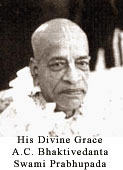
His Divine Grace A.C.
Bhaktivedanta Swami Prabhupada
Concord
Monitor
- June 5, 2007 - SPIEGEL INTERVIEW WITH AFRICAN
ECONOMICS EXPERT "For God's Sake, Please Stop the Aid!" SPIEGEL:
Mr. Shikwati, the G8 summit at Gleneagles is about to beef up the
development aid for Africa...
Shikwati: ... for God's sake, please just stop.
SPIEGEL: Stop? The industrialized nations of the West want to eliminate
hunger and poverty.
Shikwati: Such intentions have been damaging our continent for the past
40 years. If the industrial nations really want to help the Africans,
they should finally terminate this awful aid. The countries that have
collected the most development aid are also the ones that are in the
worst shape. Despite the billions that have poured in to Africa, the
continent remains poor. go
to story
Human
society, at the present moment, is not in the darkness of oblivion. It
has made rapid progress in the field of material comforts, education
and economic development throughout the entire world. But there is a
pinprick somewhere in the social body at large, and therefore there are
large-scale quarrels, even over less important issues. There is need of
a clue as to how humanity can become one in peace, friendship and
prosperity with a common cause. Srimad-Bhagavatam will fill this need,
for it is a cultural presentation for the respiritualization of the
entire human society. more
Recently,
at a medical convention held in New Delhi, our honorable prime minister
made the following observation in his speech:
We
go in for public health, sanitation, and all kinds of preventive
measures rather than wait for people to fall ill and then treat them.
Why not apply that principle in the larger sphere and prevent social
diseases that, left untreated, we will have to deal with later in a
much more difficult form? So when wise men like you gather together,
perhaps you might think of the ills and diseases of humanity as a whole
that create so many conflicts and troubles and impede human progress.
Factually,
whatever problems crop up in the world are caused by the mind. Pandits
have researched the scriptures thoroughly and held many discussions on
this topic. If we can follow the example set by the subjects of King
Ambarisha, who under his guidance concentrated their minds on the lotus
feet of Lord Krishna, then the mind can be cured of all ills. Any other
process will bring upon us the fate described by Prahlada Maharaja in
the Srimad-Bhagavatam (5.18.12): harav abhaktasya
kuto mahad-gunah manorathenasati dhavato bahih
... a person devoid of devotional service and engaged in material
activities has no good qualities. Even if he is adept at the practice
of mystic yoga or the honest endeavor of maintaining his family
and relatives, he must be driven by his own material speculations and
must engage in the service of the Lord's external energy. How can there
be any good qualities in such a man?
The only way to cure this mental disease is to wholeheartedly follow
Lord Chaitanya's instruction to chant the holy names of Krishna. This
will cleanse the heart of all impurities. Until this esoteric truth is
propagated widely, the world will remain deprived of the panacea that
cures all mental diseases. Our honorable prime minister should
seriously consider this. If the number of Lord Krishna's devotees even
slightly increases, there will immediately be a resurgence of peace and
prosperity in the world. For man to rise to the glorious heights of a
demigod, he needs only to revive his latent Krishna consciousness. Thus
Krishna consciousness is the greatest boon to humanity.
The mahatmas [great souls]
possess other wonderful qualities, some of which Lord Krishna describes
in the Bhagavad-gita (9.14):
satatam
kirtayanto mam
yatantash cha dridha-vratah
namasyantash cha mam bhaktya
nitya-yukta upasate
"Always chanting My glories, endeavoring with great determination,
bowing down before Me, these great souls perpetually worship Me with
great devotion."
This
text gives some hints of how to become a devotee of Lord Krishna. The
word satatam ("always") has been used to indicate that the
process of purifying one's consciousness does not depend on fruitive
activity, empiric knowledge, yoga, or on time, place, or
circumstance.
A living entity becomes free from all suffering as soon as he admits
that he is an eternal servant of Lord Krishna. Such a servant of the
Lord need not perform fruitive activity or cultivate empiric knowledge,
nor does he have to undergo any other process of purification. The only
essential factor is his intense greed for devotional service to the
Lord.
An extreme longing for Lord Krishna is the only means for attaining
Him. Thus intense, unflinching devotional service is another symptom of
a mahatma. These mahatmas execute all nine limbs of
devotional service, beginning with hearing, chanting, and remembering
the name, form, qualities, pastimes, and paraphernalia of Lord Krishna.
Such devotional service is transcendental to any mundane consideration
of time, place, or circumstance. Mahatmas are always eager to
render loving devotional service to the Lord. They tirelessly dedicate
their lives, energy, words, intelligence, body, society—everything—in
the service of the Lord.
The great endeavor the mahatma undertakes to execute devotional
service is more intense than the ordinary man's voluntary acceptance of
excessive pains and troubles to maintain his family and home. The
struggle for maintaining family and relatives is illusion, or maya.
Hence it is truly distressing. By contrast, the difficulties one
accepts in serving the Supreme Lord are transcendental, and therefore
they are a source of sublime bliss. Moreover, a person who serves the
Supreme Lord automatically serves his family. But the opposite is not
true: serving the family is not equivalent to serving the Lord. All mahatmas
agree on this point. Not only does the person who serves the Supreme
Lord serve his relatives, but he also serves the entire world of moving
and nonmoving living beings. Thus service to Lord Krishna is the prime
cause of world peace and harmony.
The mahatmas are always ready to render such service to the
Lord with great determination. In this regard His Divine Grace Srila
Bhaktisiddhanta Sarasvati Thakura once made this comment in a lecture:
The
neophyte Vaishnava devotees' ringing the bell even once during worship
of the Deity of the Supreme Lord is a million times more valuable,
spiritually and otherwise, than the charitable fruitive workers
building many hospitals, feeding thousands of the poor, or building
homes, or even the empirical philosophers' Vedic studies, meditation,
austerities, and penances.
Ignoring
Krishna does not help humanity
The
mahatmas have shown the perfect path of charity:
devotional service to the Lord. If anyone ignores this path and instead
builds hospitals, his effort to help humanity is a mere pretense.
Humanity can never reap any permanent advantage from such activities.
Indeed, the number of patients only increases along with the number of
hospitals. And as for feeding the poor, this will never eradicate
poverty, but encourage it. Frankly speaking, we are not against opening
hospitals or feeding the poor, or any other such humanitarian service.
But what we have learned from our beloved spiritual master is that when
devotional service to the Lord is neglected, every other activity is
illusory and futile. Without genuine devotional service, even opening
hospitals and feeding the poor in the name of Lord Krishna is futile.
Spiritual groups that do not strictly follow in Lord Chaitanya's line
cannot comprehend this because they do not wish to abide by the
instructions of the mahatmas. They do not follow Lord
Chaitanya's injunction to be "more humble than a blade of grass." If
they were that humble, they would give up their pride in being the doer
of good deeds, the wisest person, the most devoted, and so on.
Those who strive to emulate the mahatmas never fall prey to
passivity and regression. Their eagerness and determination to serve
the Lord steadily increase. Such followers observe spiritual occasions
like Janmashtami and Ekadashi for the pleasure of the Lord, in the way
that the previous acharyas and mahatmas have
recommended. This is devotional service proper. Because the mahatmas
are more humble than a blade of grass, they worship Lord Krishna and
everything in relation to Him. Atheists, however, exhibit a different
mentality altogether: they want to flaunt their abilities and
charitable disposition. They may pretend to serve Lord Krishna, but
their aim is "to sit on the Lord's head" once they attain perfection.
In other words, they want to usurp His position. Therefore they do not
really serve Lord Krishna, nor is He their real object of worship. The mahatmas
never associate with these demoniac people. They are fixed in their
resolve to serve the Lord, and thus they always remain connected to Him
through devotional service.
Who
is the provider?
Members
of the so-called educated class ask, "If one is busy all the
time rendering devotional service to Lord Krishna, how is one to
maintain himself and his family?" The so-called educated men think only
a fool would be blind to his immediate physical needs and uselessly
waste his time in devotional service so he could rise to the platform
of a mahatma. In fact, they think that a real mahatma
is he who strives to improve his material facilities from good to
better. They say that it is because of the economists' poor planning
that the world is facing a major crisis in food production. Both the
economists and their critics should turn to the Bhagavad-gita
(9.22) and hear what Lord Krishna has to say on this subject:
ananyash
chintayanto mam
ye janah paryupasate
tesham nityabhiyuktanam
yoga-kshemam vahamy aham
"But those who always worship Me with exclusive devotion, meditating on
My transcendental form—to them I carry what they lack, and I preserve
what they have."
It
is relevant to mention here how in the Western world one atheistic
government tried to induce the innocent citizens to embrace atheistic
views. The government sent their propagandists to proselytize the
people in the villages. They asked the innocent villagers, "Why do you
all go to church? What do you pray to God for?" The villagers simply
answered, "God gives us food." The atheists then led the villagers to
the church and asked them to pray to God for food. The villagers, of
simple faith, began to pray to God. At the end of their prayers, the
officials asked them if they had received food or not. Bewildered, the
people shook their heads. The atheists then asked the villagers to pray
to them for food, which they did. Immediately, with a look of triumph,
the atheists brought out baskets of bread. The villagers became happy
and thought that the government representatives were more responsive
and productive than God.
Alas! If only a devotee of the Lord had been present there, the
villagers' devotion would not have been molested. The neophyte
devotees' tender devotion is always susceptible to damage. But bread,
after all, does come from God, and not from the atheists. If those
villagers had been more conversant with the scriptures, the atheists
would never have been successful in their evil plan. The simple
villagers were illiterate, and hence they had no idea that the Supreme
Lord alone can give them food. If the earth did not produce grain, then
the atheists, despite their advanced material science, could never make
bread or other foods.
Many may claim that in the modern age material scientists have helped
increase agricultural yield. But we fearlessly proclaim that it is
precisely such atheistic views that have brought the world to the
present acute food crisis. If we are not careful, the day will soon
come when fruits will be reduced to just skin and seed, cows' udders
will dry up, and paddy fields will grow only grass. The scriptures
predict that these things will come to pass in the Kali-yuga.
In reality, the Supreme Lord is always protecting us. The inmates of a
prison are being punished by the government, yet the same government
feeds them and looks after them. Similarly, sinful, atheistic people,
though punished by the Lord's illusory energy (maya personified
as Durga-devi), are still fed and cared—for by the Lord Himself. And if
the Supreme Lord feeds and maintains even the worst sinners,
reprobates, and helpless souls, then what to speak of those who are
eternally surrendered to His lotus feet? He is like a king who takes
proper care of his subjects, but who especially looks after the needs
of his near and dear relatives. Therefore it is not true that a
comfortable life can be enjoyed only by those who perform ordinary
pious activities, but not by the devotees, who are free from fruitive
action and empirical knowledge. The devotees do not always suffer, for
the Supreme Lord personally takes care of them. The devotees are the
Lord's relatives and family members. Just as ordinary people feel joy
and satisfaction when they look after the needs and comforts of their
family, the Lord also feels pleasure when he tends to the well-being of
His devotees. Thus the Supreme Lord is known as Bhakta-vatsala,
"the maintainer of the devotees." But He is never referred to as Karmi-vatsala,
"the maintainer of fruitive workers," or Jñani-vatsala,
"the maintainer of empiric philosophers."
The devotees of the Lord fully depend on Him for everything, and so
whatever they do to maintain themselves and their family is favorable
to devotional surrender. Such pure souls are always fixed in devotion,
never wasting a moment in activities outside the Lord's service. They
are not assailed by materialistic desires, because everything they do
is for the Lord's pleasure. Hence they alone are truly peaceful.

 Concord
Monitor
- June 5, 2007 - SPIEGEL INTERVIEW WITH AFRICAN
ECONOMICS EXPERT
"For God's Sake, Please Stop the Aid!"
Concord
Monitor
- June 5, 2007 - SPIEGEL INTERVIEW WITH AFRICAN
ECONOMICS EXPERT
"For God's Sake, Please Stop the Aid!"