Inside
Nam Hatta
—goings-on, developments and issues important to the
disciples and followers of His Divine Grace A. C. Bhaktivedanta Swami
Prabhupada.
If
ISKCON were reformable there would be some merit in the disenfrachised
becoming enthused about the possibility of fixing the BBT,
re-establishing Gurukula, enacting DOM, etc. However, the 30+ year
"actual" record shows that no amount of commentary, contention,
conflict and speculative debate by the disenfranchised has brought
about any measurable degree of reform. The same record shows that
ISKCON has little capacity for internal reform. The conclusion can be
drawn that reform has failed and ISKCON will continue to be what it has
become under the guidance of the GBC.
When reform fails, what do the disenfranchised do? Should they continue
to express their grievances to the world until the end of their lives,
or, should they begin some kind of revolution to re-establish the
"Neglected Teachings" in the form of a new organization? The famous
"Unabomber" Theodore Kaczynski made some interesting points in his
Industrial Society and Its Future, in Point 19 of his Manifesto.
He wrote:
Revolution
is Easier than Reform
140. We hope we have convinced the reader that the system cannot be
reformed in a such a way as to reconcile freedom with technology. The
only way out is to dispense with the industrial-technological system
altogether. This implies revolution, not necessarily an armed uprising,
but certainly a radical and fundamental change in the nature of society.
141. People tend to assume that because a revolution involves a much
greater change than reform does, it is more difficult to bring about
than reform is. Actually, under certain circumstances revolution is
much easier than reform. The reason is that a revolutionary movement
can inspire an intensity of commitment that a reform movement cannot
inspire. A reform movement merely offers to solve a particular social
problem. A revolutionary movement offers to solve all problems at one
stroke and create a whole new world; it provides the kind of ideal for
which people will take great risks and make great sacrifices. For these
reasons it would be much easier to overthrow the whole technological
system than to put effective, permanent restraints on the development
of application of any one segment of technology, such as genetic
engineering, but under suitable conditions large numbers of people may
devote themselves passionately to a revolution against the
industrial-technological system. As we noted in paragraph 132,
reformers seeking to limit certain aspects of technology would be
working to avoid a negative outcome. But revolutionaries work to gain a
powerful reward—fulfillment of their revolutionary vision—and therefore
work harder and more persistently than reformers do.
142. Reform is always restrained by the fear of painful consequences if
changes go too far. But once a revolutionary fever has taken hold of a
society, people are willing to undergo unlimited hardships for the sake
of their revolution. This was clearly shown in the French and Russian
Revolutions. It may be that in such cases only a minority of the
population is really committed to the revolution, but this minority is
sufficiently large and active so that it becomes the dominant force in
society. We will have more to say about revolution in paragraphs
180-205.
Srila
Prabhupada also wrote a Manifesto outlining the foment of a spiritual
revolution. In his 960 pages of "Varnashram Teachings" he elaborated on
the creation of an alternative spiritual social system as the remedy
for the current dysfunctional global system.
Perhaps it is time for the disenfranchised to take up the banner of
cooperation in continuing the revolution begun in our lives by Srila
Prabhupada? The first step would be to give up on ISKCON as
un-reformable. The second step would be to establish a network of
association to bring us back to the basic standards and set out the
details of a Vaishnava Revolution. The third step would be to establish
a network of Communities that could gradually expand under a common
Constitution based on a Federation Model.


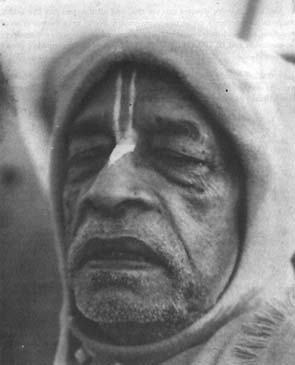 His Divine Grace A.C. Bhaktivedanta Swami
Prabhupadaa
His Divine Grace A.C. Bhaktivedanta Swami
Prabhupadaa